The tag line from the trailer for the highest grossing horror film of 1975 sums it up “It’s as if God created the Devil and gave him … Jaws!” Stephen Spielberg’s masterpiece based on Peter Benchley’s best-selling novel dominates the horror industry for 1975. Not many can compare to the fear the great white shark brought to the big screen, but many have tried. Robert Fuest releases the devil himself, in the form of Jonathan Corbis, to the southwest in The Devil’s Rain. William Castle and Jeannot Szwarc bring smaller terror to Southern California with Bug. Bill Rebane unleashes a Giant Spider Invasion upon Northern Wisconsin. David Cronenberg infests a Canadian apartment complex with They Came from Within. In Italy, Dario Argento follows the exploits of a troubled murderer in Deep Red. Kevin Conner takes a group of survivors to the uncharted land of Caprona to encounter The Land that Time Forgot. Richard O’Brien and Jim Sharman bedazzle audiences with Dr. Frank-N-Furter in the horror-sci-fi-musical The Rocky Horror Picture Show. And a small town called Amity deals with Bruce, hungry great white shark, in Jaws. Here are a few of the Movie Monsters of 1975.
MUTANT COCKROACHES in BUG
Cinematic legend William Castle filmed some of the most enjoyable scary movies of the Fifties and Sixties – The House on Haunted Hill (1959), The Tingler (1959) and 13 Ghosts (1960) to name only a few. As writer and producer, Bug is his final film in which he adapted Thomas Page’s 1973 novel The Hephaestus Plague. In the story, an earthquake rocks a small southwest town and opens a giant fissure. A swarm of giant, intelligent cockroaches escape from the newly formed crevasse and begin to set fire – by rubbing together their cerci – to plant-life, houses and cars in order to produce ash which they devour. Professor James Parmiter decides to experiment on them and creates a mutated version of the insect which is highly intelligent and flies.
JONATHAN CORBIS in THE DEVIL’S RAIN
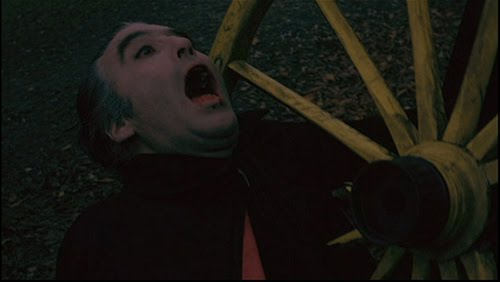
The Abominable Dr. Phibes director, Robert Fuest, helmes the low-budget Satan shocker, The Devil’s Rain which features Anton LaVey as technical advisor. Ernest Borgnine stars as films antagonist, Jonathan Corbis, the head priest of a Satanic cult terrorizing the Preston family who are guardians of a powerful demonic tome that could grant him great power. William Shatner, Eddie Albert, Ida Lupino, Joan Prather and Tom Skerrit make up the Preston family. Borgnine is menacing and evil as Jonathan Corbis when in civilian close and later in his red-robed devil-worshipping attire. Later, he becomes a true monster as he takes the form of a goat-headed devil. During the climax, Devil-Corbis, along with dozens of his followers including John Travolta in an early role, begin to melt down to a pile of goo as the Devil’s Rain washes over them.
GIANT SPIDERS in GIANT SPIDER INVASION
One of the schlockiest movies of the decade, Giant Spider Invasion has one of the most preposterous giant monsters ever put onto film. While the films does offer up some regular sized spider goodness, including a man-sized version that is thrown onto one character who then has to make the over-sized puppet act. The title monster, revealed toward the the end, is a rather fake looking furry creation mounted on top of a Volkswagen Bug with its red tail lights serving at the monster’s glowing red eyes. It’s silly, ridiculous and outright goofy - and that’s why it gets remembered. Bill Rebane directs the picture are a throwback to the giant monster movies from the Fifties. The film stars a gallery of has-been actors at that time: Steve Brodie, Robert Easton, Barbara Hale, Alan Hale Jr. and Christiane Schmidtmer. Famous for being part of Mystery Science Theater 3000, the Giant Spider of Giant Spider Invasion is a difficult visual to forget.
BRUCE, THE SHARK in JAWS
“That’s a twenty footer.” - Hooper “Twenty-five. Two tons of him.” - Quint
One creature in 1975 changed the face of horror and summer movies in 1975, Steven Spielberg’s Jaws. The film frightens audiences, creates a world-wide fascinations with great white sharks and makes going to the beach seem like the most dangerous activity man could even endure. Based on Peter Benchley’s novel, the story features a small town, Amity, on an island off the north east coast that finds is water’s have become the feeding ground for a very large great white shark. The shark’s special effects were created by Bob Mattey famously worked only sporadically which Spielberg somehow manages to make work to his advantage. Not seeing the shark for most of the picture, but knowing the creature is there - just below the surface, only adds to the terror and suspense. When the shark finally appears in all it’s glory during the final real, it’s horror cinema in full force - the creature is frightening, huge and full of teeth - lots of large sharp teeth. Scary! When he roars up out of the ocean in full view of Sheriff Brody, he exclaims to Quint “You’re going to need a bigger boat” and a legend is born. For years after the success of Jaws, imitators galore flooded the theaters bringing all kinds of giant fish, animals and assorted creatures to feast upon man, women and children alike: Grizzly, Orca, Piranha, Day of the Animals, Prophecy and many more. The film is only marred by a series of sub-par sequels: Jaws 2, Jaw 3D and (the worse of the bunch) Jaws the Revenge.
DR. FRANK-N-FURTER in ROCKY HORROR PICTURE SHOW
A cult phenomenon that knows no equal, The Rocky Horror Picture Show - a sci-fi horror musical comedy cult classic - introduced the world to Tim Currey as Dr. Frank-N-Furter. A horror movie in only the slightest of its themes, it still contains a mix of aliens invading Earth and a mad scientist stitching together his own creation. In this case, the monster is Rocky and the mad scientist is Dr. Frank-N-Furter, the most outrageous, entertaining and fashionable incarnate of a Frankenstein myth. Supported by an equally zany cast, Curry and crew failed to reach an audience at the box office; however, they climbed to the top of the midnight showing cult phenomenon of the late Seventies. Dr. Frank-N-Furter has been delighting fans of the Rocky Horror Picture Show at midnight showings since then, every weekend, somewhere in the United States.
ZUNI, THE DEVIL DOLL in TRILOGY OF TERROR
In March of 1975, Dan (Dark Shadows, Kolchak: The Night Stalker) Curtis directed the TV Movie of the Week horror anthology, Trilogy of Terror. Each episode starred Karen Black with the final episode, Amelia, containing a vicious little devil doll, a Zuni fetish doll. Amelia purchases a fetish doll as a present for her professor boy friend who teaches Anthropology. The doll is believed to house a Zuni hunter’s spirit inside it contained by a gold chain around its neck. When the gold chain falls off, the doll comes to life and begins chasing poor Amelia around the house. Zuni would go on to inspire other evil dolls that come to life such as Black Devil Doll from Hell (1984) and Chucky from the Child’s Play (1988) franchise. The Zuni doll has gone on to make brief appearances in an episode of The Venture Bros. (Are You There, God? It’s Me, Dean) and an episode of Stephen King’s Nightmares and Dreamscapes (Battleground).
Showing posts with label Doc Rotten's 666 Revelations. Show all posts
Saturday, January 15, 2011
Friday, November 12, 2010
Doc Rotten's 666 Revelations: Horror Icons of 1974
Millionaires, vampire hunters, fathers, washed-up horror actors, archaeologists, voodoo kings and chainsaw wielding maniacs, each of these varied character types is found in the horror movies of 1974 as they encounter a monster or become the monster. Calvin Lockhart hosts a dinner party to uncover which of his guests is a werewolf in Beast Must Die. William Marshall must save his daughter-in-law possessed by a West African Orisha in Abby. Don Pedro Colley is Baron Samedi, the king of the undead, in Sugar Hill which also stars Robert Quarry. Peter Cushing returns as both Baron Frankenstein in Frankenstein and the Monster from Hell and as Professor Van Helsing in The Satanic Rites of Dracula, also starring Christopher Lee as Count Dracula, and The Legend of The 7 Golden Vampires. Hammer Films also introduces Horst Janson as Captain Kronos, Vampire Hunter. Vincent Price returns to the screen as Paul Toombes in Madhouse, also starring Peter Cushing. Larry Cohen casts John P. Ryan as the troubled father in It’s Alive. Gene Wilder stars as Frederick Frankenstein creating his own Monster, Peter Boyle, with the help of hunchback lab assistant, Igor, Marty Feldman, in Mel Brook’s classic horror-comedy, Young Frankenstein. And one of the most iconic horror monsters of the Seventies, Leatherface, is brought to life by Gunnar Hansen in Tobe Hooper’s The Texas Chainsaw Massacre. It is a busy year for the Horror Icons of 1974 - here are six to remember.
CALVIN LOCKHART as TOM NEWCLIFFE in BEAST MUST DIE
Previously a member of the Royal Shakespeare Company of Stratford and a featured actor in many “blaxploitation” films of the Seventies such as Cotton Comes Harlem (1970), Melinda (1972) and Uptown Saturday Night (1974), Calvin Lockhart stars in Paul Annett’s Beast Must Die as millionaire Tom Newcliffe. Inviting together a small group of suspects to his private and secluded estate, Newcliffe reveals that one is a werewolf and must be eliminated. Confining his guest to the estate and grounds, he begins to test each one in order to deduce who is the beast. Meanwhile the trapped guests become victims of the werewolf’s attacks until Lockhart finally confronts the creature. Lockhart’s Newcliff is a driven, obsessed man, focused solely on uncovering the truth no matter the cost. Later, when his wife is stricken with the werewolf “disease,” he becomes emotional and careless, allowing himself to be bitten by the werewolf during their final confrontation. It’s a strong role, requiring a strong presence to which Lockhart is more than capable of commanding. Calvin Lockhart returns to the genre in Predator 2 (1990) as King Willie, but is best known for roles such as Biggie Smalls in Sidney Poitier’s Let’s Do It Again (1975).
HORST JANSON as KRONOS in CAPTAIN KRONOS, VAMPIRE HUNTER
German film and television actor, Horst Janson, made relatively few English language films throughout his career. Continuing their ambitious attempts at creating new, original gothic horror films, Hammer Films cast Janson as the title character in Captain Kronos, Vampire Hunter. A former soldier and master swordsman, Captain Kronos is now a renowned vampire hunter summoned to a small English village by old friend, Dr. Marcus (John Carson). Accompanied by his trusted assistant, Professor Hieronymus Grost (John Cater), and their new found companion, Carla the gypsy girl (Caroline Munro), Kronos travels to the village and begins to suspect the regal Durward family. The film fails in its attempt at a new horror franchise. While given a remarkably original and unique character, Janson fails to give the character the same spark Peter Cushing and Christopher Lee gave their creations years prior. Perhaps due to the changing climate found in theatrical horror during the Seventies, Captain Kronos never finds its audience even if it is an entertaining but somewhat underwhelming entry into horror. It also suffers from trying to be too much, bringing in swashbuckling, comedy, mystery and other elements. Even so, Janson creates a memorable character and works well alongside Cater’s Grost making an interesting and compelling team.
JOHN P. RYAN as FRANK DAVIS in IT”S ALIVE
For most of his career John P. Ryan portrays either the bad guy or tough police officers, but Larry Cohen cast him as the warmhearted father in It’s Alive. As Frank Davis, he is expecting his second child along with his wife Lenore (Sharon Farrell); however, the child is born monstrously deformed with fangs and claws. Immediately, the baby reacts to the doctors as threats, slaughters everyone except his mother in the delivery room and then escapes. Soon after, Frank Davis storms into the room to find the carnage and bloodshed. It’s a devastating scene and sets the tone for Frank for the rest of the film as he comes to terms with what his baby has become; at first denying the baby is his and even joining the hunting party tracking the monster child. Later, however, Frank realizes the child is only frightened and simply reacting to his surroundings. He tries to save the child by escaping into the sewers but is cornered by armed police. John P. Ryan returns as Frank Davis in the sequel, It Lives Again (1978) as he begins to help three other families whose children are also stricken with similar deformities. Ryan never makes as strong an impact in horror again, but does appear in genre films such as Futureworld (1976) and Class of 1999 (1990).
PETER CUSHING as PROFESSOR LAWRENCE VAN HELSING in THE LEGEND OF THE 7 GOLDEN VAMPIRES
Throughout Hammer’s horror history, Peter Cushing (along with Christopher Lee), is the flagship actor, top-billing many of its successful films and franchises. In 1974, Peter Cushing’s final Hammer films finally see release. Peter reprises his breakout role of Baron Victor Frankenstein for one last time in Frankenstein and the Monster from Hell, filmed in 1972 but released in May of 1974. He would also reprise his Van Helsing roles, both Professor Lawrence Van Helsing in The Legend of the 7 Golden Vampires and Lorrimer Van Helsing, introduced in Dracula AD 1972, in The Satanic Rites of Dracula (filmed in 1973 and then released in January of 1974). The latter would be the last time Christopher Lee would star as Count Dracula. The former finds Cushing traveling in China and crossing paths once again with Count Dracula, this time in league with the legendary Golden Vampires. Van Helsing, and his son Leyland (Robin Stewart), team up with Hsi Ching (David Chiang) and his six kung-fu brothers to destroy vampires terrorizing a local village. Peter Cushing also stars alongside Vincent Price and Robert Quarry in Madhouse this same year and in The Beast Must Die. A few years later, he stars as Grand Moff Tarkin in Star Wars (1977).
GENE WILDER as DR. FREDERICK FRANKENSTEIN in YOUNG FRANKENSTEIN
Comedian Gene Wilder teams up with reverent director Mel Brooks to create the king of parodies, Young Frankenstein. Wilder pulls double duty on the film both writing the screenplay with Brooks and starring as Dr. Frederick Frankenstein, the grandson of the infamous mad scientist. When he learns that he has inherited the family estate in Transylvania, Frederick travels abroad to the castle and meets a deranged supporting cast of characters: Teri Garr as Inga, Marty Feldman as Igor and Cloris Leachman as Frau Blucher. After discovering his grandfather’s hidden study and private library, he decides to pick up where his grandfather left off and recreate the monster (Peter Boyle). Hilarity ensues. Wilder, coming off a string of hits such as The Producers (1968), Willy Wonka & the Chocolate Factory (1971) and Blazing Saddles (1974), is charismatic and comfortable in the role of Frederick Frankenstein, creating one of his most memorable performances that, along with his script, reveal a loving tribute to the classic Universal Horror films of the 30’s and 40’s. Sticking to comedies and dramas throughout his career, Wilder returns to the genre (of sorts) to send up Gothic chillers with Haunted Honeymoon (1986), directing and writing the feature as well.
DON PEDRO COLLEY as BARON SAMEDI in SUGAR HILL
Familiar and recognizable character actor, Don Pedro Colley, provides an entertaining and amusing Baron Zamedi, Lord of the Dead, in Paul Maslansky’s Sugar Hill. Summoned by Diana “Sugar” Hill (Marki Bey) and voodoo queen Mama Maitresse (Zara Cully), Colley’s Baron Samedi is compelled to help Hill in avenging her fiancée’s murder. In exchange for her soul, Baron Samedi raises his army of zombies, providing Sugar Hill the means to enact her revenge. Colley’s tall, lanky build and expressive features, combined with a costume complete with top hat, make for a perfect Baron Samedi. When Colley is on screen, he steals the show and is enormously fun to watch. Previously seen in Beneath the Planet of the Apes (1970) as Ongaro, one of the subterranean mutants, Don Pedro Colley returns to the genre in the little seen 1995 remake of Piranha and is better known for a wide variety of TV guest appearances.
CALVIN LOCKHART as TOM NEWCLIFFE in BEAST MUST DIE
Previously a member of the Royal Shakespeare Company of Stratford and a featured actor in many “blaxploitation” films of the Seventies such as Cotton Comes Harlem (1970), Melinda (1972) and Uptown Saturday Night (1974), Calvin Lockhart stars in Paul Annett’s Beast Must Die as millionaire Tom Newcliffe. Inviting together a small group of suspects to his private and secluded estate, Newcliffe reveals that one is a werewolf and must be eliminated. Confining his guest to the estate and grounds, he begins to test each one in order to deduce who is the beast. Meanwhile the trapped guests become victims of the werewolf’s attacks until Lockhart finally confronts the creature. Lockhart’s Newcliff is a driven, obsessed man, focused solely on uncovering the truth no matter the cost. Later, when his wife is stricken with the werewolf “disease,” he becomes emotional and careless, allowing himself to be bitten by the werewolf during their final confrontation. It’s a strong role, requiring a strong presence to which Lockhart is more than capable of commanding. Calvin Lockhart returns to the genre in Predator 2 (1990) as King Willie, but is best known for roles such as Biggie Smalls in Sidney Poitier’s Let’s Do It Again (1975).
HORST JANSON as KRONOS in CAPTAIN KRONOS, VAMPIRE HUNTER
German film and television actor, Horst Janson, made relatively few English language films throughout his career. Continuing their ambitious attempts at creating new, original gothic horror films, Hammer Films cast Janson as the title character in Captain Kronos, Vampire Hunter. A former soldier and master swordsman, Captain Kronos is now a renowned vampire hunter summoned to a small English village by old friend, Dr. Marcus (John Carson). Accompanied by his trusted assistant, Professor Hieronymus Grost (John Cater), and their new found companion, Carla the gypsy girl (Caroline Munro), Kronos travels to the village and begins to suspect the regal Durward family. The film fails in its attempt at a new horror franchise. While given a remarkably original and unique character, Janson fails to give the character the same spark Peter Cushing and Christopher Lee gave their creations years prior. Perhaps due to the changing climate found in theatrical horror during the Seventies, Captain Kronos never finds its audience even if it is an entertaining but somewhat underwhelming entry into horror. It also suffers from trying to be too much, bringing in swashbuckling, comedy, mystery and other elements. Even so, Janson creates a memorable character and works well alongside Cater’s Grost making an interesting and compelling team.
JOHN P. RYAN as FRANK DAVIS in IT”S ALIVE
For most of his career John P. Ryan portrays either the bad guy or tough police officers, but Larry Cohen cast him as the warmhearted father in It’s Alive. As Frank Davis, he is expecting his second child along with his wife Lenore (Sharon Farrell); however, the child is born monstrously deformed with fangs and claws. Immediately, the baby reacts to the doctors as threats, slaughters everyone except his mother in the delivery room and then escapes. Soon after, Frank Davis storms into the room to find the carnage and bloodshed. It’s a devastating scene and sets the tone for Frank for the rest of the film as he comes to terms with what his baby has become; at first denying the baby is his and even joining the hunting party tracking the monster child. Later, however, Frank realizes the child is only frightened and simply reacting to his surroundings. He tries to save the child by escaping into the sewers but is cornered by armed police. John P. Ryan returns as Frank Davis in the sequel, It Lives Again (1978) as he begins to help three other families whose children are also stricken with similar deformities. Ryan never makes as strong an impact in horror again, but does appear in genre films such as Futureworld (1976) and Class of 1999 (1990).
PETER CUSHING as PROFESSOR LAWRENCE VAN HELSING in THE LEGEND OF THE 7 GOLDEN VAMPIRES
Throughout Hammer’s horror history, Peter Cushing (along with Christopher Lee), is the flagship actor, top-billing many of its successful films and franchises. In 1974, Peter Cushing’s final Hammer films finally see release. Peter reprises his breakout role of Baron Victor Frankenstein for one last time in Frankenstein and the Monster from Hell, filmed in 1972 but released in May of 1974. He would also reprise his Van Helsing roles, both Professor Lawrence Van Helsing in The Legend of the 7 Golden Vampires and Lorrimer Van Helsing, introduced in Dracula AD 1972, in The Satanic Rites of Dracula (filmed in 1973 and then released in January of 1974). The latter would be the last time Christopher Lee would star as Count Dracula. The former finds Cushing traveling in China and crossing paths once again with Count Dracula, this time in league with the legendary Golden Vampires. Van Helsing, and his son Leyland (Robin Stewart), team up with Hsi Ching (David Chiang) and his six kung-fu brothers to destroy vampires terrorizing a local village. Peter Cushing also stars alongside Vincent Price and Robert Quarry in Madhouse this same year and in The Beast Must Die. A few years later, he stars as Grand Moff Tarkin in Star Wars (1977).
GENE WILDER as DR. FREDERICK FRANKENSTEIN in YOUNG FRANKENSTEIN
Comedian Gene Wilder teams up with reverent director Mel Brooks to create the king of parodies, Young Frankenstein. Wilder pulls double duty on the film both writing the screenplay with Brooks and starring as Dr. Frederick Frankenstein, the grandson of the infamous mad scientist. When he learns that he has inherited the family estate in Transylvania, Frederick travels abroad to the castle and meets a deranged supporting cast of characters: Teri Garr as Inga, Marty Feldman as Igor and Cloris Leachman as Frau Blucher. After discovering his grandfather’s hidden study and private library, he decides to pick up where his grandfather left off and recreate the monster (Peter Boyle). Hilarity ensues. Wilder, coming off a string of hits such as The Producers (1968), Willy Wonka & the Chocolate Factory (1971) and Blazing Saddles (1974), is charismatic and comfortable in the role of Frederick Frankenstein, creating one of his most memorable performances that, along with his script, reveal a loving tribute to the classic Universal Horror films of the 30’s and 40’s. Sticking to comedies and dramas throughout his career, Wilder returns to the genre (of sorts) to send up Gothic chillers with Haunted Honeymoon (1986), directing and writing the feature as well.
DON PEDRO COLLEY as BARON SAMEDI in SUGAR HILL
Familiar and recognizable character actor, Don Pedro Colley, provides an entertaining and amusing Baron Zamedi, Lord of the Dead, in Paul Maslansky’s Sugar Hill. Summoned by Diana “Sugar” Hill (Marki Bey) and voodoo queen Mama Maitresse (Zara Cully), Colley’s Baron Samedi is compelled to help Hill in avenging her fiancée’s murder. In exchange for her soul, Baron Samedi raises his army of zombies, providing Sugar Hill the means to enact her revenge. Colley’s tall, lanky build and expressive features, combined with a costume complete with top hat, make for a perfect Baron Samedi. When Colley is on screen, he steals the show and is enormously fun to watch. Previously seen in Beneath the Planet of the Apes (1970) as Ongaro, one of the subterranean mutants, Don Pedro Colley returns to the genre in the little seen 1995 remake of Piranha and is better known for a wide variety of TV guest appearances.
Saturday, November 6, 2010
Doc Rotten's 666 Revelations: Scream Queens of 1974
Scream Queens in 1974 are a broad mix of roles. Some are monsters, such as Juliet Mills in Beyond the Door, Marki Bey in Sugar Hill and Carol Speed in Abby, while others begin defining the final girl, such as Olivia Hussey in Black Christmas and Marilyn Burns in The Texas Chainsaw Massacre. Many are supporting roles such as Caroline Munro in Captain Kronos, Vampire Hunter and Julie Ege in The Legend of Seven Golden Vampires. Terri Garr even gets to play the “straight man” in Young Frankenstein, while Madeline Kahn and Cloris Leachman hone their comedic skills in the Mel Brooks' classic. And Sharon Ferrell deals with the fears of giving birth to a monster in It’s Alive. Be they monsters, final girls or comic relief, here are six of the Scream Queens of 1974.
JULIET MILLS as JESSICA BARNETT in BEYOND THE DOOR
The Exorcist (1973) gave birth to a wave of exorcism movies looking to cash in on its box office success. The devil and his demon counterparts seem to be taking possession of innocent women across the world at an alarming rate. In Italy, director Ovidio G. Assonitis, cast actress Juliet Mills in Beyond the Door. In the story, Mills’ character, Jessica Barrett, pregnant with her third child, starts to show signs of possession. When Richard Johnson shows up to help it turns out the baby may just be the son of the devil. Much like Linda Blair’s Regan, she begins to not only physically change appearance but also spit green bile, speak in tongues and foul language, and spin her head around 180 degrees. Mills, best known as Phoebe Figalilly in the TV series Nanny and the Professor, only stars in two genre films during her career, this film and Waxwork II: Lost In Time (1992).
OLIVIA HUSSEY as JESSICA BRADFORD in BLACK CHRISTMAS
1974 is a landmark year for the final girl concept of horror films, especially slasher films in their infancy. The Texas Chainsaw Massacre along with Black Christmas both propel their female leads into the final girl role. For Bob (Porky’s and A Christmas Story) Clark’s Black Christmas, also known as Silent Night, Evil Night, Olivia Hussey steps into the role of Jessica Bradford who must survive when a murderer invades her sorority house. The exotic beauty is previously best known for the star-making, celebrated role of Juliet in Franco Zeffirelli’s Romeo and Juliet (1968). In the Canadian low-budget shocker, she adds to the tension by starting the film very cool, very in control and then degenerating into a nervous, frightened wreck by the film’s conclusion. Hussey breaks new ground with this role and provides a blueprint for many final girls to follow, from Jamie Lee Curtis in Halloween (1977) to Carol Kane in When A Stranger Calls (1980) to every final girl in the Friday the Thirteenth franchise.
CAROLINE MUNRO AS CARLA in CAPTAIN KRONOS, VAMPIRE HUNTER
Caroline Munro continues her rise to fame with the role of Carla in Hammer’s Captain Kronos, Vampire Hunter. On their way to Durwood Manor, Captain Kronos (Horst Janson) and Professor Hieronymus Grost (John Carter) encounter the young gypsy girl Carla and free her from imprisonment. Carla becomes a student of Kronos, learning the ways of hunting and killing vampires. She also becomes romantically involved with Kronos. While she does become the victim – twice – Carla is more a member of the man’s club in the Hammer chiller. She assists Grost in tracking the vampires (burying toads!) and is a key element to gaining entrance back into Durwood Manor to confront the vampires. With this film, Munro completes her contract with Hammer; however, she follows the director, Brian Clemens, to her next role as Margiana in The Golden Voyage of Sinbad (1974) and later becomes a Bond girl in The Spy Who Loved Me (1977). She continues to make a splash in the Horror genre including the slasher flick The Last Horror Film (1982).
MARKI BEY as DIANA “SUGAR” HILL in SUGAR HILL
As does Carol Speed in Abby (1974), Marki Bey plays the title in Paul Maslansky’s Sugar Hill role as Diana “Sugar” Hill. When Diana Hill’s fiancée meets an untimely death, she sets out to get revenge on those responsible, including the local crime lord named Morgan played by horror icon Robert Quarry. She enlists the help of the voodoo queen Mama Maitresse (Zara Cully) to strike a deal with the Lord of the Dead, Baron Zamedi (Don Pedro Colley). She is given control over the Baron’s voodoo zombies to track down and kill Morgan and his gang. When “Sugar” needs to awaken the zombies, she too changes - transforming from the straight-haired, beautiful Diana Hill into a Coffy clone, complete with Pam Grier’s afro and white jump suit. She is also cursed with some of the silliest dialog ever. Still Marki Bey manages to make an impression and carries her striking wardrobe quite well. She has a relatively short career starting with The Landlord (1970) and ending with TV appearances on Charlie’s Angels (1977), Starsky and Hutch (1977-1979) and Trapper John, M.D. (1979).
MARILYN BURNS as SALLY HARDESTY in TEXAS CHAINSAW MASSACRE
If Olivia Hussey began to draft the outline for the final girl in horror films; Marilyn Burns solidified the concept in Tobe Hooper’s The Texas Chainsaw Massacre as Sally Hardesty. Traveling with her brother Franklin (Paul A. Partain) and friends, Jerry (Allen Danzinger), Kirk (William Vail) and Pam (Teri McMinn) in Texas, the group encounters a family of cannibals, including the homicidal Leatherface. One by one, the family begins to pick off the youngster until Sally is left to fend for herself. Somehow she survives Leatherface’s attacks and flees capture all the while avoiding becoming lunch and being crafted into a fashion accessory. While her role is often reduced to screaming and then screaming some more, she still manages to bring a strength to the character and an intelligence that enables her to escape. Before she can though, she is put through hell: jumping out a second story window, being kidnapped by the owner of a nearby gas station, bound, gagged and sat before the family dinner, surviving “Grandpa’s” hammer and leaping through a window yet again before being chased by the chainsaw wielding Leatherface. Sally Hardesty may be one of the most important female roles for the horror genre, influencing final girls in movies such as Halloween (1978), Friday the Thirteenth (1980) and most every slasher film in the Eighties. Marilyn Burns appears in the genre again in Helter Skelter (1976) and Eaten Alive (1977).
TERRI GARR as INGA in YOUNG FRANKENSTEIN
The horror comedy is a tough genre-blending beast to successfully master. Mel Brook’s lucked out when he cast the beautiful and talented Terri Garr as Inga, the gypsy lab assistant, in his comedy/horror masterpiece, Young Frankenstein. Staring alongside Gene Wilder as Dr. Frederick Frankenstein and Marty Feldman as Igor, Terri Garr must become their straight man. But she is far more than that. In her breakthrough performance, she is able to hold her own beside the two comedic talents and show her funny bone as well. The script also affords her some of the funnier lines in the movie as well and she is able to upstage both Wilder and Feldman from time to time. The three make a delightful trio that finds few to rival their timing, charm and banter. Who else could deliver the line “He vould have an enormous schwanzstucker” with such finesse? Garr follows Young Frankenstein with very few genre related pictures, such as Close Encounters of the Third Kind (1977), and becomes more famous for her comedic roles in Oh, God! (1977), Tootsie (1982) and Mr. Mom (1983).
JULIET MILLS as JESSICA BARNETT in BEYOND THE DOOR
The Exorcist (1973) gave birth to a wave of exorcism movies looking to cash in on its box office success. The devil and his demon counterparts seem to be taking possession of innocent women across the world at an alarming rate. In Italy, director Ovidio G. Assonitis, cast actress Juliet Mills in Beyond the Door. In the story, Mills’ character, Jessica Barrett, pregnant with her third child, starts to show signs of possession. When Richard Johnson shows up to help it turns out the baby may just be the son of the devil. Much like Linda Blair’s Regan, she begins to not only physically change appearance but also spit green bile, speak in tongues and foul language, and spin her head around 180 degrees. Mills, best known as Phoebe Figalilly in the TV series Nanny and the Professor, only stars in two genre films during her career, this film and Waxwork II: Lost In Time (1992).
OLIVIA HUSSEY as JESSICA BRADFORD in BLACK CHRISTMAS
1974 is a landmark year for the final girl concept of horror films, especially slasher films in their infancy. The Texas Chainsaw Massacre along with Black Christmas both propel their female leads into the final girl role. For Bob (Porky’s and A Christmas Story) Clark’s Black Christmas, also known as Silent Night, Evil Night, Olivia Hussey steps into the role of Jessica Bradford who must survive when a murderer invades her sorority house. The exotic beauty is previously best known for the star-making, celebrated role of Juliet in Franco Zeffirelli’s Romeo and Juliet (1968). In the Canadian low-budget shocker, she adds to the tension by starting the film very cool, very in control and then degenerating into a nervous, frightened wreck by the film’s conclusion. Hussey breaks new ground with this role and provides a blueprint for many final girls to follow, from Jamie Lee Curtis in Halloween (1977) to Carol Kane in When A Stranger Calls (1980) to every final girl in the Friday the Thirteenth franchise.
CAROLINE MUNRO AS CARLA in CAPTAIN KRONOS, VAMPIRE HUNTER
Caroline Munro continues her rise to fame with the role of Carla in Hammer’s Captain Kronos, Vampire Hunter. On their way to Durwood Manor, Captain Kronos (Horst Janson) and Professor Hieronymus Grost (John Carter) encounter the young gypsy girl Carla and free her from imprisonment. Carla becomes a student of Kronos, learning the ways of hunting and killing vampires. She also becomes romantically involved with Kronos. While she does become the victim – twice – Carla is more a member of the man’s club in the Hammer chiller. She assists Grost in tracking the vampires (burying toads!) and is a key element to gaining entrance back into Durwood Manor to confront the vampires. With this film, Munro completes her contract with Hammer; however, she follows the director, Brian Clemens, to her next role as Margiana in The Golden Voyage of Sinbad (1974) and later becomes a Bond girl in The Spy Who Loved Me (1977). She continues to make a splash in the Horror genre including the slasher flick The Last Horror Film (1982).
MARKI BEY as DIANA “SUGAR” HILL in SUGAR HILL
As does Carol Speed in Abby (1974), Marki Bey plays the title in Paul Maslansky’s Sugar Hill role as Diana “Sugar” Hill. When Diana Hill’s fiancée meets an untimely death, she sets out to get revenge on those responsible, including the local crime lord named Morgan played by horror icon Robert Quarry. She enlists the help of the voodoo queen Mama Maitresse (Zara Cully) to strike a deal with the Lord of the Dead, Baron Zamedi (Don Pedro Colley). She is given control over the Baron’s voodoo zombies to track down and kill Morgan and his gang. When “Sugar” needs to awaken the zombies, she too changes - transforming from the straight-haired, beautiful Diana Hill into a Coffy clone, complete with Pam Grier’s afro and white jump suit. She is also cursed with some of the silliest dialog ever. Still Marki Bey manages to make an impression and carries her striking wardrobe quite well. She has a relatively short career starting with The Landlord (1970) and ending with TV appearances on Charlie’s Angels (1977), Starsky and Hutch (1977-1979) and Trapper John, M.D. (1979).
MARILYN BURNS as SALLY HARDESTY in TEXAS CHAINSAW MASSACRE
If Olivia Hussey began to draft the outline for the final girl in horror films; Marilyn Burns solidified the concept in Tobe Hooper’s The Texas Chainsaw Massacre as Sally Hardesty. Traveling with her brother Franklin (Paul A. Partain) and friends, Jerry (Allen Danzinger), Kirk (William Vail) and Pam (Teri McMinn) in Texas, the group encounters a family of cannibals, including the homicidal Leatherface. One by one, the family begins to pick off the youngster until Sally is left to fend for herself. Somehow she survives Leatherface’s attacks and flees capture all the while avoiding becoming lunch and being crafted into a fashion accessory. While her role is often reduced to screaming and then screaming some more, she still manages to bring a strength to the character and an intelligence that enables her to escape. Before she can though, she is put through hell: jumping out a second story window, being kidnapped by the owner of a nearby gas station, bound, gagged and sat before the family dinner, surviving “Grandpa’s” hammer and leaping through a window yet again before being chased by the chainsaw wielding Leatherface. Sally Hardesty may be one of the most important female roles for the horror genre, influencing final girls in movies such as Halloween (1978), Friday the Thirteenth (1980) and most every slasher film in the Eighties. Marilyn Burns appears in the genre again in Helter Skelter (1976) and Eaten Alive (1977).
TERRI GARR as INGA in YOUNG FRANKENSTEIN
The horror comedy is a tough genre-blending beast to successfully master. Mel Brook’s lucked out when he cast the beautiful and talented Terri Garr as Inga, the gypsy lab assistant, in his comedy/horror masterpiece, Young Frankenstein. Staring alongside Gene Wilder as Dr. Frederick Frankenstein and Marty Feldman as Igor, Terri Garr must become their straight man. But she is far more than that. In her breakthrough performance, she is able to hold her own beside the two comedic talents and show her funny bone as well. The script also affords her some of the funnier lines in the movie as well and she is able to upstage both Wilder and Feldman from time to time. The three make a delightful trio that finds few to rival their timing, charm and banter. Who else could deliver the line “He vould have an enormous schwanzstucker” with such finesse? Garr follows Young Frankenstein with very few genre related pictures, such as Close Encounters of the Third Kind (1977), and becomes more famous for her comedic roles in Oh, God! (1977), Tootsie (1982) and Mr. Mom (1983).
Labels:
1974,
Doc Rotten's 666 Revelations,
Scream Queens
Saturday, October 16, 2010
Doc Rotten's 666 Revelations: Movie Monsters of 1974
After the box office smash of Exorcist in 1973, horror movie monsters begin to shift from the more traditional (or innocent) monsters of yesteryear to the more visceral and violent monsters to come. Even the studios producing familiar monsters made significant efforts to revise the visuals and the surrounding tales with movies such as Frankenstein and the Monster from Hell, The Legend of the Seven Golden Vampires, Madhouse with Vincent Price, The Mutations and Captain Kronos, Vampire Hunter; even the Knights Templar return in The Ghost Galleon. Then Mel Brooks’ brilliant satire of the genre, Young Frankenstein, all but closes the door on these types of monster, effectively putting the classic Universal Monster archetype to rest. Frankenstein, Dracula and the Werewolf are now replaced by the Living Dead (Let Sleeping Corpses Lie), murderous infant beasts (It’s Alive), possessed men and women (Beyond the Door), and frightening deranged madmen (Leatherface in Texas Chainsaw Massacre). A new age in horror is dawning and here are six of the Movie Monsters from 1974 that illustrate the passing of the torch.
MONSTER FROM HELL in FRANKENSTEIN AND THE MONSTER FROM HELL
Hammer Films produces their final entry into their Frankenstein series with Peter Cushing returning as Victor Frankenstein in Frankenstein and the Monster from Hell. For the creature, Hammer hires David (Darth Vader) Prowse once again, this time to portray the hulking beast, the Monster from Hell. The story follows a young doctor, Simon Helder (Shane Briant), who is following in Dr. Frankenstein’s footsteps, performing similar experiments in life after death. The superstitious locals don’t take too kindly to his practice and judge him criminally insane, institutionalizing him to the local asylum. Upon arriving at the asylum, Simon discovers to his amazement that Victor Frankenstein is also a patient there, but has managed to take over the asylum controlling the director’s every action. Together they pick up Frankenstein’s experiments, using body parts from deceased mental patients. Things go wrong and they create a misshapen monstrosity. The monster’s design, while not as successful as the creature from The Curse of Frankenstein (1957), is more grotesque than the creatures found in other Hammer Frankenstein films such as Evil of Frankenstein (1964), Frankenstein Created Woman (1967) and Frankenstein Must be Destroyed (1969).
BABY DAVIS in IT’S ALIVE
Perhaps the most innocent of film characters is a child and what better way to corrupt the innocence of traditional horror than turning an infant baby into a nightmarish, blood-thirsty creature. Larry Cohen transforms the fears of every expecting parent into a B-Movie monster movie classic with It’s Alive when the newborn baby of the Davis family is revealed to be a murdering, ferocious beast. In a shocking scene, the delivery room is turned into a blood bath leaving only the mother alive and the child missing. Rick Baker’s classic monster baby design is kept hidden from view for most of the film and is only seen in flashes and never for a prolong time, a fanged mouth here, a claw swiping across the screen there and a full figure glimpse form time to time. The sounds and implications of the monster’s actions are more disturbing left to the imagination, as in most cases, if the monster would have been seen in full view it would have become silly and ineffective. However, the monster’s simple design remains one of the more frightening visages of a child monster the cinemas have ever seen.
LIVING DEAD in LET SLEEPING CORPSES LIE
In 1968, George Romero introduced Pennsylvania, US Cinemas and the World to the flesh eating ghoul variation to the zombie mythos with Night of the Living Dead. The film’s success and influence takes some time to be recognized in horror cinema. In Europe, director Jorge Grau crafts a disturbing tale of the walking dead with Let Sleeping Corpses Lie, also known as Don’t Open the Window and The Living Dead at Manchester Morgue. In Grau’s film, the dead are brought to life by a experimental machine being used by the government to control the spread of insects. The zombies in Manchester are gut munching creatures that feast on living humans, much like Romero’s zombies, presented for the first time in full color. Let Sleeping Corpses Lie is a relatively tame movie when compared to the zombie classics to come, but it is not without its share of graphically shocking scenes where a number of zombies feast on fresh kills. It does not make a huge impact and is considered by many to be an overlooked classic. It would take George Romero’s Dawn of the Dead (1978) and Lucio Fulci’s Zombie (1979) to make the modern zombie a cinema horror staple.
THE FREAK in THE MUTATIONS
In a cross between freak human mutation and mad-scientist experimentation rogue biologist Professor (Donald Pleasence ) Nolter genetically engineers his victims into plant-like monsters in Jack Cardiff’s The Mutations. Instead of creating a monster from the parts of other humans like Frankenstein, Nolter begins to alter the DNA of his victims theorizing that he can accelerate the natural selection of evolution. These are very modern twists to the standard themes found in horror films of its time. Unfortunately the film fails to live up to the promise of its themes and becomes sloppy and awkward in its pacing. The creature effects are striking, however, blending plant like qualities into human like features. Along with these monstrosities, the film also features a number of human oddities straight out of Ripley’s Believe It or Not and Tom (Dr. Who) Baker as a deformed man from a local carnival freak show. Gone are the man-monster creations of Frankenstein, forever replaced by more disturbing blending of man and beast with gene-splicing, cloning and other modern science marvels.
LEATHERFACE in THE TEXAS CHAINSAW MASSACRE
Alfred Hitchcock stunned audiences with Psycho (1960) and, with Norman Bates, helped create the madman/serial killer movie monster. Others would follow, but not many make the impact that Tobe Hooper achieves with The Texas Chainsaw Massacre. While the film has an entire family of deranged killers, it’s the chainsaw wielding threat of Leatherface that makes the lasting impression. His towering height and face covered with the leathered flesh of past victims, Leatherface storms onto the screen in a shocking display of violence, suddenly attacking one of the protagonists entering into the kitchen, hammering him into submission and slamming the kitchen door shut. There is no blood; but the sudden appearance of the killer, combined with a barrage of sounds, creates a rush of fear and chaos. Later, Leatherface trades the meat-tenderizer for the titular chainsaw and solidifies his position in horror history. Tobe Hooper and Gunnar Hansen (as Leatherface) pave the way for future killer madmen such as Michael Myers in Halloween (1978), Jason Voorhees in the Friday the Thirteenth series and Freddy Kruger in A Nightmare on Elm Street (1984).
VAMPIRES in LEGEND OF THE SEVEN GOLDEN VAMPIRES
Hammer Films produces their final entry into their Dracula franchise with Legend of Seven Golden Vampires. For this film, Hammer teams up with the Hong Kong film company Shaw Brothers, blending European horror with Kung Fu action. Christopher Lee refuses to return as Dracula and the character is reduced to appearing in bookend set pieces now played by John Forbes-Robertson. Thankfully, Peter Cushing returns as Van Helsing. The focus, for most of the picture, is shifted to the Asian hopping-vampire variations known here as the Seven Golden Vampires. Their appearance is very different from the classic vampires, looking nothing like the gothic, romantic Count Dracula. Their faces are rotting and zombie like, mostly seen beneath their elaborate ceremonial masks, and they are seen riding horses and hopping around in slow-motion. And they know Kung Fu – sort of. Cushing’s aging Van Helsing, along with a team of seven Kung Fu brothers (and one sister), defeats the vampires and their zombie horde and then confronts Count Dracula for the final time.
MONSTER FROM HELL in FRANKENSTEIN AND THE MONSTER FROM HELL
Hammer Films produces their final entry into their Frankenstein series with Peter Cushing returning as Victor Frankenstein in Frankenstein and the Monster from Hell. For the creature, Hammer hires David (Darth Vader) Prowse once again, this time to portray the hulking beast, the Monster from Hell. The story follows a young doctor, Simon Helder (Shane Briant), who is following in Dr. Frankenstein’s footsteps, performing similar experiments in life after death. The superstitious locals don’t take too kindly to his practice and judge him criminally insane, institutionalizing him to the local asylum. Upon arriving at the asylum, Simon discovers to his amazement that Victor Frankenstein is also a patient there, but has managed to take over the asylum controlling the director’s every action. Together they pick up Frankenstein’s experiments, using body parts from deceased mental patients. Things go wrong and they create a misshapen monstrosity. The monster’s design, while not as successful as the creature from The Curse of Frankenstein (1957), is more grotesque than the creatures found in other Hammer Frankenstein films such as Evil of Frankenstein (1964), Frankenstein Created Woman (1967) and Frankenstein Must be Destroyed (1969).
BABY DAVIS in IT’S ALIVE
Perhaps the most innocent of film characters is a child and what better way to corrupt the innocence of traditional horror than turning an infant baby into a nightmarish, blood-thirsty creature. Larry Cohen transforms the fears of every expecting parent into a B-Movie monster movie classic with It’s Alive when the newborn baby of the Davis family is revealed to be a murdering, ferocious beast. In a shocking scene, the delivery room is turned into a blood bath leaving only the mother alive and the child missing. Rick Baker’s classic monster baby design is kept hidden from view for most of the film and is only seen in flashes and never for a prolong time, a fanged mouth here, a claw swiping across the screen there and a full figure glimpse form time to time. The sounds and implications of the monster’s actions are more disturbing left to the imagination, as in most cases, if the monster would have been seen in full view it would have become silly and ineffective. However, the monster’s simple design remains one of the more frightening visages of a child monster the cinemas have ever seen.
LIVING DEAD in LET SLEEPING CORPSES LIE
In 1968, George Romero introduced Pennsylvania, US Cinemas and the World to the flesh eating ghoul variation to the zombie mythos with Night of the Living Dead. The film’s success and influence takes some time to be recognized in horror cinema. In Europe, director Jorge Grau crafts a disturbing tale of the walking dead with Let Sleeping Corpses Lie, also known as Don’t Open the Window and The Living Dead at Manchester Morgue. In Grau’s film, the dead are brought to life by a experimental machine being used by the government to control the spread of insects. The zombies in Manchester are gut munching creatures that feast on living humans, much like Romero’s zombies, presented for the first time in full color. Let Sleeping Corpses Lie is a relatively tame movie when compared to the zombie classics to come, but it is not without its share of graphically shocking scenes where a number of zombies feast on fresh kills. It does not make a huge impact and is considered by many to be an overlooked classic. It would take George Romero’s Dawn of the Dead (1978) and Lucio Fulci’s Zombie (1979) to make the modern zombie a cinema horror staple.
THE FREAK in THE MUTATIONS
In a cross between freak human mutation and mad-scientist experimentation rogue biologist Professor (Donald Pleasence ) Nolter genetically engineers his victims into plant-like monsters in Jack Cardiff’s The Mutations. Instead of creating a monster from the parts of other humans like Frankenstein, Nolter begins to alter the DNA of his victims theorizing that he can accelerate the natural selection of evolution. These are very modern twists to the standard themes found in horror films of its time. Unfortunately the film fails to live up to the promise of its themes and becomes sloppy and awkward in its pacing. The creature effects are striking, however, blending plant like qualities into human like features. Along with these monstrosities, the film also features a number of human oddities straight out of Ripley’s Believe It or Not and Tom (Dr. Who) Baker as a deformed man from a local carnival freak show. Gone are the man-monster creations of Frankenstein, forever replaced by more disturbing blending of man and beast with gene-splicing, cloning and other modern science marvels.
LEATHERFACE in THE TEXAS CHAINSAW MASSACRE
Alfred Hitchcock stunned audiences with Psycho (1960) and, with Norman Bates, helped create the madman/serial killer movie monster. Others would follow, but not many make the impact that Tobe Hooper achieves with The Texas Chainsaw Massacre. While the film has an entire family of deranged killers, it’s the chainsaw wielding threat of Leatherface that makes the lasting impression. His towering height and face covered with the leathered flesh of past victims, Leatherface storms onto the screen in a shocking display of violence, suddenly attacking one of the protagonists entering into the kitchen, hammering him into submission and slamming the kitchen door shut. There is no blood; but the sudden appearance of the killer, combined with a barrage of sounds, creates a rush of fear and chaos. Later, Leatherface trades the meat-tenderizer for the titular chainsaw and solidifies his position in horror history. Tobe Hooper and Gunnar Hansen (as Leatherface) pave the way for future killer madmen such as Michael Myers in Halloween (1978), Jason Voorhees in the Friday the Thirteenth series and Freddy Kruger in A Nightmare on Elm Street (1984).
VAMPIRES in LEGEND OF THE SEVEN GOLDEN VAMPIRES
Hammer Films produces their final entry into their Dracula franchise with Legend of Seven Golden Vampires. For this film, Hammer teams up with the Hong Kong film company Shaw Brothers, blending European horror with Kung Fu action. Christopher Lee refuses to return as Dracula and the character is reduced to appearing in bookend set pieces now played by John Forbes-Robertson. Thankfully, Peter Cushing returns as Van Helsing. The focus, for most of the picture, is shifted to the Asian hopping-vampire variations known here as the Seven Golden Vampires. Their appearance is very different from the classic vampires, looking nothing like the gothic, romantic Count Dracula. Their faces are rotting and zombie like, mostly seen beneath their elaborate ceremonial masks, and they are seen riding horses and hopping around in slow-motion. And they know Kung Fu – sort of. Cushing’s aging Van Helsing, along with a team of seven Kung Fu brothers (and one sister), defeats the vampires and their zombie horde and then confronts Count Dracula for the final time.
Labels:
1974,
Doc Rotten's 666 Revelations,
Movie Monsters
Wednesday, September 8, 2010
Doc Rotten's 666 Revelations: Scream Queens of 1973
When discussing Scream Queens in 1973, it is impossible not to include Linda Blair as Regan MacNeil in The Exorcist. She is undeniably the most recognizable horror icon of the decade, a decade that introduces us to Bruce the shark, Michael Myers and Leatherface. Guided by William Friedkin’s Golden Globe winning direction, Blair’s performance leaves a lasting and influential mark on horror. It is rare a horror movie is recognized by the Academy of Motion Picture Arts and Sciences and the Golden Globes, but the innocent looking thirteen year old was nominated for her supporting role. Ellen Burstyn as Chris MacNeil was also nominated for lead actress. It’s a stellar year for scream queens. But they aren’t the only ones who gave memorably and commendable performances this year. Julie Christie plummets into depression and sorrow in the harrowing Don’t Look Now. Pamela Franklin faces her greatest fears in Legend of Hell House. Pam Grier leads a voodoo clan and battles William Marshall in Scream, Blacula, Scream. And Margot Kidder gives a dual performance as both Danielle and Dominique in Brian DePalma’s Sisters. Here are the six Scream Queens who made an impression on horror cinema in 1973.
JULIE CHRISTIE as LAURA BAXTER in DON’T LOOK NOW
In Nicholas Roeg’s haunting film Don’t Look Now, actress Julie Christie plays Laura Baxter who struggles to deal with the loss of her child who drowned in a pond. Her husband, John (played by Donald Sutherland), takes a job in Venice, Italy (restoring an old church) and brings her along in hopes to overcome her depression and repair their stressed relationship. While John works, Laura encounters and befriends two elderly women, one of whom is blind, psychic and claims to be in contact with her deceased daughter. While her husband is suspicious of their motives, Laura is given great comfort from the pair and continues to visit them even after tragedy strikes again upon the films conclusion. Julie Christie, a cherished, sought-after and well respected actress, brings a deep sorrow and passion to the character of Laura Baxter. In a rich, cerebral film that requires such, Christie provides a rare mature, realistic woman, simultaneously strong and fragile. Christie, who previously starred in Fahrenheit 451 (1965), returns to the genre in Demon Seed (1977).
ELLEN BURSTYN as CHRIS MACNEIL in THE EXORCIST
In a year of strong female horror roles, Ellen Burstyn is nominated for an Academy Award and a Golden Globe for her portrayal of Chris MacNeil in William Friedkin’s The Exorcist. Burstyn stars as the mother of a young teenager who is possessed by an evil spirit. Chris MacNeil is a successful, strong woman and a single mother, dealing with the stress of her job, her divorce and her blossoming teen. As the strange and frightening events that surround her daughter increase, she faces them head on, resilient When the doctors (and science) continually fail her, she fights back insisting on answers and options. After all further options prove unsuccessful, and believing her daughter is now possessed by an evil spirit, she reaches out to the church for answers, requesting an exorcism. Finding the church, like the doctors and psychiatrists before them, are hesitant to believe her plight, she fights yet again for her daughter, convincing Father Karras to move forward with her request. It is her role as the ever-vigilant mother who will never give up on her daughter that anchors the film and keeps the audience invested in the narrative. Burstyn never truly returns to genre, but does finally receive the Oscar the following year for her role in Alice Doesn’t Live Here Anymore (1974).
LINDA BLAIR as REGAN MACNEIL in THE EXORCIST
For her role as the possessed young Regan MacNeil in Exorcist, Linda Blair was nominated for Academy Award for Best Supporting Actress, she is also nominated for the Golden Globe in the same category. Unfortunately as it was learned her role was handled too heavily with special effects and voice work from Mercedes McCambridge, that the likelihood of winning diminished considerably (She does win the Golden Globe however). While such a sour downturn continues to haunt much of Linda Blair’s career, her role provides a powerful and haunting performance that deserves such recognition. As the story unfolds, she refers innocently to an invisible friend in the basement named Captain Howdy, then as the horror begins to take hold and she behaves unexpectedly or encounters unexplainable phenomenon, and she must brave the cold and unfeeling methods of modern science. The audience feels her pain along with her as she braves needles and probes and huge machines wailing loudly as they examine her. Then, when medicine fails her, a psychiatrist is brought in to examine her and he hypnotizes her in hope of speaking with the mysterious Captain Howdy. When the demon insider her is brought to the forefront, Blair’s Regan transforms into a snarling, twisted version of her previous self. From then on, she quickly becomes the possessed child most horror fans are familiar with, her face scarred with lashes from holy water, eyes glazed over white and spitting bile at the exorcists trying to save her. Hers is a brave and strong performance. Linda Blair returns to the franchise with Exorcist II: The Heretic (1977) and the genre with films like Hell Night (1981).
PAMELA FRANKLIN as FLORENCE TANNER in LEGEND OF HELL HOUSE
When Dr. Lionel Barrett (Clive Revill) is hired to investigate the haunting of the Belasco Mansion, he brings along his wife, Ann (Gayle Hunnicutt) and two different type of psychics to uncover the truth behind the supernatural events, Ben Fischer (Roddy McDowell) a physical medium and Florence Tanner, a spiritual medium. The young, attractive, naive and vulnerable Tanner is played by Pamela Franklin and it is through her that the research team (and the audience) first encounter the spirit (or perhaps spirits) inhabiting Hell House. She is in constant confrontation with Barrett who distrusts her and her methods and believes the spirits are only scientific “energy” and not spirits. Through her intent to prove Barrett wrong, and never wavering in her beliefs, she invokes the spirits, succumbs to a spiritual molestation and jeopardizes her safety. She even overcomes her own fear and faces down the spirit of the house during the film’s climax.
PAM GRIER as LISA FORTIER in SCREAM, BLACULA, SCREAM
Pam Grier makes a striking Voodoo Queen as Lisa Fortier in Scream, Blacula, Scream. The rising star quickly shows she can hold her own against the Shakespearean trained actor playing Blacula, William Marshall. The make a formidable pair. When Mama Loa passes, her adopted apprentice, Lisa Fortier, is chosen over her own son, Willis, to be her successor. Willis resurrects Blacula to keep Lisa from becoming the new Voodoo Queen, but the black prince becomes enamored with her instead. Unlike most scream queens in similar horror features, Grier’s character is as entrenched in the supernatural workings as the antagonist and she is armed with knowledge and tools typically scripted for the likes of Professor Van Helsing as played by Peter Cushing. Not only does she battle and defeat Blacula, but she also saves the male lead from certain death as well. Bravo.
MARGOT KIDDER as DANIELLE/DOMINIQUE in SISTERS
As director Brian De Palma evolved into a respected director often compared favorably to the legendary Alfred Hitchcock, he offered the challenging role of Danielle Breton and Dominique Blanchion in the film Sisters. De Palma places Kidder in the Norman Bates role with Sisters and heavy-handily draws inspiration from Psycho (and other classic Hitchcock films). However, he brings with him a technique he soon claims as his own: the split screen. This technique is used to great effect in Sisters as it also visually represents the Danielle and Dominique’s fractured personalities, separation from each other, and simultaneous points of views throughout the film. In one of her earliest roles, Kidder leans on De Palma’s skills to illustrate the characters she is given to portray in Sisters and elevates her performance above what it may have been in other hands. Margot Kidder follows Sisters up with other Seventies horror classics such as Black Christmas (1974), The Reincarnation of Peter Proud (1975) and The Amityville Horror (1979). During this time, she is offered the lead female role in the big screen adaptation of DC Comics’ iconic costumed hero, Superman (1977), and forever becomes associated with the character Lois Lane.
JULIE CHRISTIE as LAURA BAXTER in DON’T LOOK NOW
In Nicholas Roeg’s haunting film Don’t Look Now, actress Julie Christie plays Laura Baxter who struggles to deal with the loss of her child who drowned in a pond. Her husband, John (played by Donald Sutherland), takes a job in Venice, Italy (restoring an old church) and brings her along in hopes to overcome her depression and repair their stressed relationship. While John works, Laura encounters and befriends two elderly women, one of whom is blind, psychic and claims to be in contact with her deceased daughter. While her husband is suspicious of their motives, Laura is given great comfort from the pair and continues to visit them even after tragedy strikes again upon the films conclusion. Julie Christie, a cherished, sought-after and well respected actress, brings a deep sorrow and passion to the character of Laura Baxter. In a rich, cerebral film that requires such, Christie provides a rare mature, realistic woman, simultaneously strong and fragile. Christie, who previously starred in Fahrenheit 451 (1965), returns to the genre in Demon Seed (1977).
ELLEN BURSTYN as CHRIS MACNEIL in THE EXORCIST
In a year of strong female horror roles, Ellen Burstyn is nominated for an Academy Award and a Golden Globe for her portrayal of Chris MacNeil in William Friedkin’s The Exorcist. Burstyn stars as the mother of a young teenager who is possessed by an evil spirit. Chris MacNeil is a successful, strong woman and a single mother, dealing with the stress of her job, her divorce and her blossoming teen. As the strange and frightening events that surround her daughter increase, she faces them head on, resilient When the doctors (and science) continually fail her, she fights back insisting on answers and options. After all further options prove unsuccessful, and believing her daughter is now possessed by an evil spirit, she reaches out to the church for answers, requesting an exorcism. Finding the church, like the doctors and psychiatrists before them, are hesitant to believe her plight, she fights yet again for her daughter, convincing Father Karras to move forward with her request. It is her role as the ever-vigilant mother who will never give up on her daughter that anchors the film and keeps the audience invested in the narrative. Burstyn never truly returns to genre, but does finally receive the Oscar the following year for her role in Alice Doesn’t Live Here Anymore (1974).
LINDA BLAIR as REGAN MACNEIL in THE EXORCIST
For her role as the possessed young Regan MacNeil in Exorcist, Linda Blair was nominated for Academy Award for Best Supporting Actress, she is also nominated for the Golden Globe in the same category. Unfortunately as it was learned her role was handled too heavily with special effects and voice work from Mercedes McCambridge, that the likelihood of winning diminished considerably (She does win the Golden Globe however). While such a sour downturn continues to haunt much of Linda Blair’s career, her role provides a powerful and haunting performance that deserves such recognition. As the story unfolds, she refers innocently to an invisible friend in the basement named Captain Howdy, then as the horror begins to take hold and she behaves unexpectedly or encounters unexplainable phenomenon, and she must brave the cold and unfeeling methods of modern science. The audience feels her pain along with her as she braves needles and probes and huge machines wailing loudly as they examine her. Then, when medicine fails her, a psychiatrist is brought in to examine her and he hypnotizes her in hope of speaking with the mysterious Captain Howdy. When the demon insider her is brought to the forefront, Blair’s Regan transforms into a snarling, twisted version of her previous self. From then on, she quickly becomes the possessed child most horror fans are familiar with, her face scarred with lashes from holy water, eyes glazed over white and spitting bile at the exorcists trying to save her. Hers is a brave and strong performance. Linda Blair returns to the franchise with Exorcist II: The Heretic (1977) and the genre with films like Hell Night (1981).
PAMELA FRANKLIN as FLORENCE TANNER in LEGEND OF HELL HOUSE
When Dr. Lionel Barrett (Clive Revill) is hired to investigate the haunting of the Belasco Mansion, he brings along his wife, Ann (Gayle Hunnicutt) and two different type of psychics to uncover the truth behind the supernatural events, Ben Fischer (Roddy McDowell) a physical medium and Florence Tanner, a spiritual medium. The young, attractive, naive and vulnerable Tanner is played by Pamela Franklin and it is through her that the research team (and the audience) first encounter the spirit (or perhaps spirits) inhabiting Hell House. She is in constant confrontation with Barrett who distrusts her and her methods and believes the spirits are only scientific “energy” and not spirits. Through her intent to prove Barrett wrong, and never wavering in her beliefs, she invokes the spirits, succumbs to a spiritual molestation and jeopardizes her safety. She even overcomes her own fear and faces down the spirit of the house during the film’s climax.
PAM GRIER as LISA FORTIER in SCREAM, BLACULA, SCREAM
Pam Grier makes a striking Voodoo Queen as Lisa Fortier in Scream, Blacula, Scream. The rising star quickly shows she can hold her own against the Shakespearean trained actor playing Blacula, William Marshall. The make a formidable pair. When Mama Loa passes, her adopted apprentice, Lisa Fortier, is chosen over her own son, Willis, to be her successor. Willis resurrects Blacula to keep Lisa from becoming the new Voodoo Queen, but the black prince becomes enamored with her instead. Unlike most scream queens in similar horror features, Grier’s character is as entrenched in the supernatural workings as the antagonist and she is armed with knowledge and tools typically scripted for the likes of Professor Van Helsing as played by Peter Cushing. Not only does she battle and defeat Blacula, but she also saves the male lead from certain death as well. Bravo.
MARGOT KIDDER as DANIELLE/DOMINIQUE in SISTERS
As director Brian De Palma evolved into a respected director often compared favorably to the legendary Alfred Hitchcock, he offered the challenging role of Danielle Breton and Dominique Blanchion in the film Sisters. De Palma places Kidder in the Norman Bates role with Sisters and heavy-handily draws inspiration from Psycho (and other classic Hitchcock films). However, he brings with him a technique he soon claims as his own: the split screen. This technique is used to great effect in Sisters as it also visually represents the Danielle and Dominique’s fractured personalities, separation from each other, and simultaneous points of views throughout the film. In one of her earliest roles, Kidder leans on De Palma’s skills to illustrate the characters she is given to portray in Sisters and elevates her performance above what it may have been in other hands. Margot Kidder follows Sisters up with other Seventies horror classics such as Black Christmas (1974), The Reincarnation of Peter Proud (1975) and The Amityville Horror (1979). During this time, she is offered the lead female role in the big screen adaptation of DC Comics’ iconic costumed hero, Superman (1977), and forever becomes associated with the character Lois Lane.
Labels:
1973,
Doc Rotten's 666 Revelations,
Scream Queens
Tuesday, August 24, 2010
Doc Rotten's 666 Revelations: Movie Monsters of 1973
1973 is the year everything changed. The genre has been toying with “maturing” over the recent years with entries such as Rosemary’s Baby (1968) and Night of the Living Dead (1968). But with The Exorcist, horror shakes the world with its mature themes and creates a blockbuster. There are plenty of movie monsters this year; some cash in on the craze, others become adolescent and get looked over. The bar is raised. Along with the devil himself, possessing young, innocent Regan MacNeil, 1973 sees the return of a few Seventies fiends such as Blacula in Scream, Blacula, Scream, the Knights Templar in Return of the Blind Dead, Paul Nachy’s Waldermar Daninsky in Curse of the Devil and Christopher Lee’s Count Dracula in Satanic Rites of Dracula. Yul Brynner shows up as the robotic gunslinger in Westworld and Peter Cushing faces the Creeping Flesh. Along with Blacula, blaxploitation unleashes Blackenstein. Frightening killers sharpen their knives in Don’t Look Now, Sisters and Horror Hospital. Strother Martin turns into Dirk Benedict a ssssnake in SSSSSSS and Vincent Price chews up the scenery in Theater of Blood. Here are 6 of the Movie Monsters that scare up box office receipts (or TV ratings) in 1973.
POSSESSED REGAN MACNEIL in EXORCIST
Suddenly there was a face to the old saying “The devil made me do it” when a demon possesses a Georgetown pre-teen in director William Friedkin’s adaptation of William Blatty’s Exorcist. Audiences find themselves subjected to unthinkable visuals: Regan levitates above her bed, her head spins completely around, she vomits green bile, and she stages unspeakable acts with a crucifix. The demon spouts foul obscenities to Regan’s mother and the priests who perform the exorcism in order to cast the creature out. The soundtrack only amplifies the audible fear with booming sound effects and Tubular Bells. Perhaps the greatest movie monster of the decade comes to life in the face of a child and the movie going public and the future of horror cinema will never, ever be the same.
CREEPING FLESH in CREEPING FLESH
Peter Cushing and Christopher Lee are the go-to team for UK horror films. Starting with Hammer film’s Curse of Frankenstein in 1957, the duo makes classic gothic chiller after another, such as Horror of Dracula (1958), the Mummy (1959), Dr. Terror’s House of Horrors (1965) and more. They manage to elevate themselves to the highest of horror icons status alongside the likes of Boris Karloff, Bela Lugosi, Lon Chaney, Jr. and Vincent Price. Hammer and Amicus commonly snatch the two up to star in horror outings. One such pairing is Creeping Flesh in 1973, directed by Freddie Francis, where Cushing’s scientist Emmanual Hildern returns from New Guinea with a large humanoid skeleton. He soon discovers, while cleaning the specimen, that when the bones come in contact with water flesh begins to grow on its surface. Fearing the being is evil, Hildern keeps the skeleton dry and hidden safely in his laboratory, until his corrupt half-brother, James (Christopher Lee), steals it on a dark, stormy night. The rain regenerates the creature into the creeping flesh and it begins to wreak havoc.
GUNSLINGER in WESTWORLD
In an early example of technology gone wild, Westworld is a popular adult attraction where lifelike robots co-inhabiting the park for entertainment begin to malfunction, go against their programming and kill off the patrons. Famous author Michael Crichton writes and directs the feature starring Richard (Love at First Bite) Benjamin and James (The Car, Amityville Horror) Brolin as two of the park’s guests. When all hell breaks loose, the pair must face the most fearsome of the renegade robots, the Gunslinger, played by the legendary western actor Yul Brynner. Stoic, silent, slow moving, and unstoppable, the malfunctioning maniac continues to pursue Benjamin from park to park, rising after each defeat in actions similar to but predating Halloween’s Michael Myers from John Carpenter and Terminator’s T-800 from James Cameron. Even after being destroyed during the conclusion of Westworld, the Gunslinger returns briefly in the sequel Futureworld in 1976.
BLACKENSTEIN in BLACKENSTEIN
Hoping to recapture the success they had with Blacula, AIP hires director William A. Levey to helm a twist on the Mary Shelley classic Frankenstein under the title Blackenstein. The end result, unfortunately, is a bit silly and ineffective. Much like Blacula, the title monster appears very much like its Universal Monster cousin, but with an Afro. In the story, a Vietnam vet, Eddie Turner, returns from the war horribly disfigured having lost all his limbs. His fiancée, Doctor Winifred Walker, takes him to Dr. Stein, volunteering him for experimental procedures that may return him to his former self. Instead, they create a monster that goes on a rampage. Where William Marshall at least challenges Bela Lugosi or Christopher Lee in their similar roles, John De Su does little more that stumbling around, becoming a parody of the Universal Monster played by Boris Karloff, Lon Chaney, Jr. and Glenn Strange.
CREATURES in DON’T BE AFRAID OF THE DARK
In John Newland’s TV horror movie of the week, Don’t Be Afraid of the Dark, Kim Darby and Jim Hutton inherit a creepy two-story Victorian house that they soon discover has menacing creatures hidden in the dark. Sally (Darby) Farnham uncovers a bricked up fireplace in a locked up study and unwittingly unleashes a gaggle of miniature monsters terrorizing her night after night. Makeup man, Mike Hancock, gives the little beasts a frightening visage with shriveled up little heads. They hide in the shadows and whisper at Sally from the dark and threaten to drag her into the pit below the fireplace from whence they came. A minor success when it came out in 1973, as a TV movie, it became all but forgotten afterwards until Guillermo Del Toro recently announce that he was producing a theatrical remake for 2011.
THE MAD DOCTOR STORM in HORROR HOSPITAL
Michael Gough stars as Doctor Christian Storm in Antony Balch’s Horror Hospital. Doctor Storm runs a “health clinic” where he cures degenerates by lobotomizing them into brain-dead zombies. He also drives around in a limousine equipped with a retractable blade and basket for decapitating his victims. He also pals around with a creepy dwarf, Skip Martin from Vampire Circus, who assists him in tracking down new candidates for his experiments. In Horror Hospital, Doctor Storm is a campy, dark humored, gore-infused take on the mad doctor theme, on science gone mad. Things turn sour for Storm when he targets the niece of his assistant (Aunt Judy) and her friends when they arrive at the clinic in search of missing friends. Doctor Storm, in the capable hands of Michael Gough (Trog, Horrors of the Black Museum, Konga), is a prime example of Seventies evil scientist looking to save the world in his own twisted, disturbed, maniacal way.
POSSESSED REGAN MACNEIL in EXORCIST
Suddenly there was a face to the old saying “The devil made me do it” when a demon possesses a Georgetown pre-teen in director William Friedkin’s adaptation of William Blatty’s Exorcist. Audiences find themselves subjected to unthinkable visuals: Regan levitates above her bed, her head spins completely around, she vomits green bile, and she stages unspeakable acts with a crucifix. The demon spouts foul obscenities to Regan’s mother and the priests who perform the exorcism in order to cast the creature out. The soundtrack only amplifies the audible fear with booming sound effects and Tubular Bells. Perhaps the greatest movie monster of the decade comes to life in the face of a child and the movie going public and the future of horror cinema will never, ever be the same.
CREEPING FLESH in CREEPING FLESH
Peter Cushing and Christopher Lee are the go-to team for UK horror films. Starting with Hammer film’s Curse of Frankenstein in 1957, the duo makes classic gothic chiller after another, such as Horror of Dracula (1958), the Mummy (1959), Dr. Terror’s House of Horrors (1965) and more. They manage to elevate themselves to the highest of horror icons status alongside the likes of Boris Karloff, Bela Lugosi, Lon Chaney, Jr. and Vincent Price. Hammer and Amicus commonly snatch the two up to star in horror outings. One such pairing is Creeping Flesh in 1973, directed by Freddie Francis, where Cushing’s scientist Emmanual Hildern returns from New Guinea with a large humanoid skeleton. He soon discovers, while cleaning the specimen, that when the bones come in contact with water flesh begins to grow on its surface. Fearing the being is evil, Hildern keeps the skeleton dry and hidden safely in his laboratory, until his corrupt half-brother, James (Christopher Lee), steals it on a dark, stormy night. The rain regenerates the creature into the creeping flesh and it begins to wreak havoc.
GUNSLINGER in WESTWORLD
In an early example of technology gone wild, Westworld is a popular adult attraction where lifelike robots co-inhabiting the park for entertainment begin to malfunction, go against their programming and kill off the patrons. Famous author Michael Crichton writes and directs the feature starring Richard (Love at First Bite) Benjamin and James (The Car, Amityville Horror) Brolin as two of the park’s guests. When all hell breaks loose, the pair must face the most fearsome of the renegade robots, the Gunslinger, played by the legendary western actor Yul Brynner. Stoic, silent, slow moving, and unstoppable, the malfunctioning maniac continues to pursue Benjamin from park to park, rising after each defeat in actions similar to but predating Halloween’s Michael Myers from John Carpenter and Terminator’s T-800 from James Cameron. Even after being destroyed during the conclusion of Westworld, the Gunslinger returns briefly in the sequel Futureworld in 1976.
BLACKENSTEIN in BLACKENSTEIN
Hoping to recapture the success they had with Blacula, AIP hires director William A. Levey to helm a twist on the Mary Shelley classic Frankenstein under the title Blackenstein. The end result, unfortunately, is a bit silly and ineffective. Much like Blacula, the title monster appears very much like its Universal Monster cousin, but with an Afro. In the story, a Vietnam vet, Eddie Turner, returns from the war horribly disfigured having lost all his limbs. His fiancée, Doctor Winifred Walker, takes him to Dr. Stein, volunteering him for experimental procedures that may return him to his former self. Instead, they create a monster that goes on a rampage. Where William Marshall at least challenges Bela Lugosi or Christopher Lee in their similar roles, John De Su does little more that stumbling around, becoming a parody of the Universal Monster played by Boris Karloff, Lon Chaney, Jr. and Glenn Strange.
CREATURES in DON’T BE AFRAID OF THE DARK
In John Newland’s TV horror movie of the week, Don’t Be Afraid of the Dark, Kim Darby and Jim Hutton inherit a creepy two-story Victorian house that they soon discover has menacing creatures hidden in the dark. Sally (Darby) Farnham uncovers a bricked up fireplace in a locked up study and unwittingly unleashes a gaggle of miniature monsters terrorizing her night after night. Makeup man, Mike Hancock, gives the little beasts a frightening visage with shriveled up little heads. They hide in the shadows and whisper at Sally from the dark and threaten to drag her into the pit below the fireplace from whence they came. A minor success when it came out in 1973, as a TV movie, it became all but forgotten afterwards until Guillermo Del Toro recently announce that he was producing a theatrical remake for 2011.
THE MAD DOCTOR STORM in HORROR HOSPITAL
Michael Gough stars as Doctor Christian Storm in Antony Balch’s Horror Hospital. Doctor Storm runs a “health clinic” where he cures degenerates by lobotomizing them into brain-dead zombies. He also drives around in a limousine equipped with a retractable blade and basket for decapitating his victims. He also pals around with a creepy dwarf, Skip Martin from Vampire Circus, who assists him in tracking down new candidates for his experiments. In Horror Hospital, Doctor Storm is a campy, dark humored, gore-infused take on the mad doctor theme, on science gone mad. Things turn sour for Storm when he targets the niece of his assistant (Aunt Judy) and her friends when they arrive at the clinic in search of missing friends. Doctor Storm, in the capable hands of Michael Gough (Trog, Horrors of the Black Museum, Konga), is a prime example of Seventies evil scientist looking to save the world in his own twisted, disturbed, maniacal way.
Labels:
-Articles,
1973,
Doc Rotten's 666 Revelations
Thursday, August 12, 2010
Doc Rotten's 666 Revelations: Horror Icons of 1972
In 1972, Peter Cushing appears in a number of horror treats: Tales from the Crypt, Fear in the Night, Asylum and Dracula, AD 1972 with Christopher Lee. Cushing also guest stars with Vincent Price returning as Dr. Anton Phibes in Dr. Phibes Rises Again. In this picture Price goes up against Robert Quarry as Darrus Biederbeck. Quarry also stars as Khorda in Deathmaster. William Marshall creates blaxploitation’s successful twist on the vampire legend in Blacula. Robert Tayman, Anthony “Corlan” Higgins and David Prowse terrorize a small village in Vampire Circus. David Hess represents the worst of humanity as Krug Stillo in Last House on the Left. Cornel Wilde battles the Gargoyles on TV and David Janssen uncovers a mystery in Moon of the Wolf. Joseph Cotton battles Baron Blood for Mario Bava and Paul Naschy returns as Waldemar Daninsky in Fury of the Werewolf. Here are six of these roles that have become Horror Icons of 1972.
WILLIAM MARSHALL as PRINCE MAMUWALDE in BLACULA
With his Shakespearean background, a deep thunderous voice and an ominous presence, William Marshall, as Prince Mamuwalde, delivers one of Seventies’ most memorable vampires, Count Blacula. The actor, the character and the film, Blacula directed by William Crain, far exceeds the limitations of its blaxploitation origins. Marshall treats the material with all the gusto and respect any producer could hope for. Before the ending credits, he sets himself admirably beside Christopher Lee, Bela Lugosi and Robert Quarry. Marshall’s vampire Count is visually threatening, much like a Mr. Hyde to a Dr. Jekyll, his features pronounced with facial hair and makeup. To his credit, Marshall’s Prince Mamuwalde carries himself with confidence and credibility while wearing Victorian attire in the modern settings, bringing much needed nobility to the character. And, as Count Blacula, he is also very capable of bringing the ferocity and power to the vampire with the help of subtle but effective make-up and his booming, commanding voice. William Marshall returns to role in Scream, Blacula, Scream (1973) and plays a priest in the Exorcist-derived Abby (1974).
SAM ELLIOT as PICKETT SMITH in FROGS
Early in his career, Sam Elliot stars in the ecological, animals-run-amok horror flick, Frogs. Lacking his signature mustache and looking incredibly, almost unrecognizably young, Elliot, as Pickett Smith, arrives on a private island and encounters a wealthy family led by the family patriarch Jason Crockett, played by Ray Milland. Soon he finds himself surrounded by mystery, corruption and danger as the local reptile population begins to strike back, killing the inhabitants one by one. Somehow, he must survive the onslaught and rescue his new-found love, Karen Crockett played by Joan Van Ark. A few years earlier, Sam Elliot made his feature film debut in Butch Cassidy and the Sundance Kid, which also stars his future wife Katherine Ross; however, they would not actually meet until they co-starred together in The Legacy (1979, another of Elliot’s rare horror genre pictures). In the 2000s, after becoming know primarily for Westerns or as Wade Garrett in Road House (1989), Sam Elliot stars in a few super-hero fantasy films, such as Hulk (2002) and Ghost Rider (2007).
DAVID HESS as KRUG STILLO in LAST HOUSE ON THE LEFT
Krug Stillo, from the film Last House on the Left, is perhaps one of the most vile antagonists in the Seventies. Played by David Hess, Krug leads a group of escaped convict that brutalize two young friends, Phylis and Mari, in the remote countryside. Hess, with unkempt curly locks and unshaven face, wreaks of evil, lacking all compassion for humankind, even in some cases his own son and companions. Murdering one of the two, Phylis, and leaving the other, Mari, for dead, Stillo and his gang move on to Mari’s home where they begin to size up and terrorize her parents, who must fight for their survival and avenge their daughter’s death. Before filming Last House on the Left, Hess had a career in music writing songs for Elvis Presley, Sal Mineo and the Ames Brothers. David Hess would go on to play roles in House on the Edge of the Park (1980) and Swamp Thing (1982) again with Wes Craven directing.
PETER CUSHING as ARTHUR GRIMSDYKE in TALES FROM THE CRYPT
In Tales from the Crypt, Peter Cushing gets a chance to play the living dead, as Arthur Grimsdyke who rises from the grave to get revenge on the neighbors who wrong him. This role illustrates Peter Cushing’s extraordinary talents, from the visual mannerisms he gives Grimsdye to emotions he effortless breathes into him. Cushing’s Grimsdyke is endearing, innocent, sad, and lost; he loves interacting with the neighborhood children and he deeply misses his deceased wife. He becomes the target of a family of wealthy neighbors who want him out of the neighborhood and possession of his property; they keep Grimsdyke from the children he adores, they take his dogs that bring him comfort and send him spiteful Valentine's Day cards. When he receives the demeaning greeting cards, it is difficult not to feel Grimsdyke’s heart break, from the crackle in his voice, to the wimper in his lips and the sadness in his eyes. It is arguably the strongest single performance in all of Amicus’ anthology films and one of Peter Cushing’s most touching. Then he gets to portray a zombie, a first for his career, rising from his grave is haunting splendor with visuals that are as memorable as the performance already praised.
ANTHONY “CORLAN” HIGGINS as EMIL in VAMPIRE CIRCUS
Cast as Emil in Hammer’s Vampire Circus, Anthony Corlan, later known as Anthony Higgins, was poised to give a break-out performance. But it did not happen, perhaps due to an overcrowded cast and an over-ambitious script or perhaps due to timing. At this time, Hammer films’ output and quality begins to decline and public tastes begin to move toward more sensational, modern and visceral horrors such as Exorcist (1973), Jaws (1975), Carrie (1976) and Dawn of the Dead (1978). Like many of the horror-stars-to-be at that time, becoming a horror icon is not in the cards. He does, however, have a successful career on stage, TV and screen in UK, becoming one of the few actors to play both Sherlock Holmes and Professor Moriarity. In Vampire Circus, he is given very few lines but strikes a handsome and memorable vampire. Higgin’s Emil foreshadows the vampires of present day cinema, young, handsome, quiet and deceptively dangerous. In this very film, Count Mitterhaus represents the Victorian upper class vampire given birth by Bram Stoker, while Emil represents the lower class vampire that can easily hide among humanity.
ROBERT QUARRY as KHORDA in DEATHMASTER
Robert Quarry rose to fame playing Count Yorga in Count Yorga, Vampire and Return of Count Yorga. In 1972, he plays another unique vampire character, Khorda, in Deathmaster for director Ray Danton, costarring Bobby Picket who recorded the Halloween hit, Monster Mash. For Deathmaster, Quarry dons long hair and sports groovy attire to become a Guru for a hippie commune. It’s a very interesting and entertaining twist on the vampire myth and a very progressive placement of the legend into modern culture, much more so than previous attempts to update vampires such as Count Yorga, Vampire, Blacula and Dracula AD, 1972. Unlike Dracula and even Yorga, Khorda cannot be accused of wearing outdated Victorian clothes; this vampire attempts to blend in to his surroundings, wearing modern clothes, becoming the leader of the commune he has targeted and feeds upon. Robert Quarry continues to fill horror roles throughout the Seventies, including Dr. Phibes Rises Again (1973), Madhouse (1974) and Sugar Hill (1974).
WILLIAM MARSHALL as PRINCE MAMUWALDE in BLACULA
With his Shakespearean background, a deep thunderous voice and an ominous presence, William Marshall, as Prince Mamuwalde, delivers one of Seventies’ most memorable vampires, Count Blacula. The actor, the character and the film, Blacula directed by William Crain, far exceeds the limitations of its blaxploitation origins. Marshall treats the material with all the gusto and respect any producer could hope for. Before the ending credits, he sets himself admirably beside Christopher Lee, Bela Lugosi and Robert Quarry. Marshall’s vampire Count is visually threatening, much like a Mr. Hyde to a Dr. Jekyll, his features pronounced with facial hair and makeup. To his credit, Marshall’s Prince Mamuwalde carries himself with confidence and credibility while wearing Victorian attire in the modern settings, bringing much needed nobility to the character. And, as Count Blacula, he is also very capable of bringing the ferocity and power to the vampire with the help of subtle but effective make-up and his booming, commanding voice. William Marshall returns to role in Scream, Blacula, Scream (1973) and plays a priest in the Exorcist-derived Abby (1974).
SAM ELLIOT as PICKETT SMITH in FROGS
Early in his career, Sam Elliot stars in the ecological, animals-run-amok horror flick, Frogs. Lacking his signature mustache and looking incredibly, almost unrecognizably young, Elliot, as Pickett Smith, arrives on a private island and encounters a wealthy family led by the family patriarch Jason Crockett, played by Ray Milland. Soon he finds himself surrounded by mystery, corruption and danger as the local reptile population begins to strike back, killing the inhabitants one by one. Somehow, he must survive the onslaught and rescue his new-found love, Karen Crockett played by Joan Van Ark. A few years earlier, Sam Elliot made his feature film debut in Butch Cassidy and the Sundance Kid, which also stars his future wife Katherine Ross; however, they would not actually meet until they co-starred together in The Legacy (1979, another of Elliot’s rare horror genre pictures). In the 2000s, after becoming know primarily for Westerns or as Wade Garrett in Road House (1989), Sam Elliot stars in a few super-hero fantasy films, such as Hulk (2002) and Ghost Rider (2007).
DAVID HESS as KRUG STILLO in LAST HOUSE ON THE LEFT
Krug Stillo, from the film Last House on the Left, is perhaps one of the most vile antagonists in the Seventies. Played by David Hess, Krug leads a group of escaped convict that brutalize two young friends, Phylis and Mari, in the remote countryside. Hess, with unkempt curly locks and unshaven face, wreaks of evil, lacking all compassion for humankind, even in some cases his own son and companions. Murdering one of the two, Phylis, and leaving the other, Mari, for dead, Stillo and his gang move on to Mari’s home where they begin to size up and terrorize her parents, who must fight for their survival and avenge their daughter’s death. Before filming Last House on the Left, Hess had a career in music writing songs for Elvis Presley, Sal Mineo and the Ames Brothers. David Hess would go on to play roles in House on the Edge of the Park (1980) and Swamp Thing (1982) again with Wes Craven directing.
PETER CUSHING as ARTHUR GRIMSDYKE in TALES FROM THE CRYPT
In Tales from the Crypt, Peter Cushing gets a chance to play the living dead, as Arthur Grimsdyke who rises from the grave to get revenge on the neighbors who wrong him. This role illustrates Peter Cushing’s extraordinary talents, from the visual mannerisms he gives Grimsdye to emotions he effortless breathes into him. Cushing’s Grimsdyke is endearing, innocent, sad, and lost; he loves interacting with the neighborhood children and he deeply misses his deceased wife. He becomes the target of a family of wealthy neighbors who want him out of the neighborhood and possession of his property; they keep Grimsdyke from the children he adores, they take his dogs that bring him comfort and send him spiteful Valentine's Day cards. When he receives the demeaning greeting cards, it is difficult not to feel Grimsdyke’s heart break, from the crackle in his voice, to the wimper in his lips and the sadness in his eyes. It is arguably the strongest single performance in all of Amicus’ anthology films and one of Peter Cushing’s most touching. Then he gets to portray a zombie, a first for his career, rising from his grave is haunting splendor with visuals that are as memorable as the performance already praised.
ANTHONY “CORLAN” HIGGINS as EMIL in VAMPIRE CIRCUS
Cast as Emil in Hammer’s Vampire Circus, Anthony Corlan, later known as Anthony Higgins, was poised to give a break-out performance. But it did not happen, perhaps due to an overcrowded cast and an over-ambitious script or perhaps due to timing. At this time, Hammer films’ output and quality begins to decline and public tastes begin to move toward more sensational, modern and visceral horrors such as Exorcist (1973), Jaws (1975), Carrie (1976) and Dawn of the Dead (1978). Like many of the horror-stars-to-be at that time, becoming a horror icon is not in the cards. He does, however, have a successful career on stage, TV and screen in UK, becoming one of the few actors to play both Sherlock Holmes and Professor Moriarity. In Vampire Circus, he is given very few lines but strikes a handsome and memorable vampire. Higgin’s Emil foreshadows the vampires of present day cinema, young, handsome, quiet and deceptively dangerous. In this very film, Count Mitterhaus represents the Victorian upper class vampire given birth by Bram Stoker, while Emil represents the lower class vampire that can easily hide among humanity.
ROBERT QUARRY as KHORDA in DEATHMASTER
Robert Quarry rose to fame playing Count Yorga in Count Yorga, Vampire and Return of Count Yorga. In 1972, he plays another unique vampire character, Khorda, in Deathmaster for director Ray Danton, costarring Bobby Picket who recorded the Halloween hit, Monster Mash. For Deathmaster, Quarry dons long hair and sports groovy attire to become a Guru for a hippie commune. It’s a very interesting and entertaining twist on the vampire myth and a very progressive placement of the legend into modern culture, much more so than previous attempts to update vampires such as Count Yorga, Vampire, Blacula and Dracula AD, 1972. Unlike Dracula and even Yorga, Khorda cannot be accused of wearing outdated Victorian clothes; this vampire attempts to blend in to his surroundings, wearing modern clothes, becoming the leader of the commune he has targeted and feeds upon. Robert Quarry continues to fill horror roles throughout the Seventies, including Dr. Phibes Rises Again (1973), Madhouse (1974) and Sugar Hill (1974).
Labels:
1972,
Doc Rotten's 666 Revelations,
Horror Icons
Wednesday, August 11, 2010
Doc Rotten's 666 Revelations: Scream Queens of 1972
Few female roles in 1972 would rise above the supporting role, the damsel-in-distress. One of those roles would go to Sandra Cassel in Last House on the Left where she is the primary focus of much of the picture, struggling to survive unimaginable horrors. Joan Collins would face a maniacal Santa in Tales from the Crypt in a role where she would be protagonist and antagonist simultaneously. Stephanie Beacham shines in Dracula AD, 1972, but ends up being little more than the victim. She fares a little better than Caroline Munro in the same picture, who manages to overcome the script and turns in a memorable performance. Elke Sommer faces off Baron Blood for Mario Bava and Fiona Lewis has to square off against both Dr. Phibes (Vincent Price) and Darrus Biederbeck (Robert Quarry) in Dr. Phibes Rises Again. Adrienne Corri is a human leader of a band of undead gypsies in Vampire Circus and Joan Van Ark faces a swamp full of deadly reptiles in Frogs. Here are six of the Scream Queens who left an impression in 1972.
STEPHANIE BEACHAM as JESSICA VAN HELSING in DRACULA AD, 1972
As Jessica Van Helsing, the Granddaughter of Lorrimer Van Helsing, Stephenie Beacham portrays the modern gothic scream queen in Dracula AD,1972, Hammer film’s attempt to modernize the Dracula legend. Both captivating and charismatic, Beacham manages to bring more to the role of Jessica than the script demands. In the story, Jessica is no more than a pawn, a way for the resurrected Dracula to get revenge on the Van Helsing family name. To her credit, she does manage to glue together the Victorian elements to the present 1972 day settings. Regrettably, however, she is never allowed to inherit her family namesake and all the vampire vanquishing is left to her grandfather, played by Peter Cushing. It seems audiences in 1972 were not ready for a Buffy-like character just yet. Stephanie Beacham is also cast in And Now the Screaming Starts costarring again with Peter Cushing.
CAROLINE MUNRO as LAURA BELLOWS in DRACULA AD, 1972
Dracula AD, 1972 is a significant movie in Caroline Munro’s career. Up until this point she was a model that had appeared in a number of films, such as The Abominable Dr. Phibes and Dr. Phibes Rises Again. With this film, it all changes as Hammer films signs her to a long-term contract. While, the role is a supporting role, it ignites the acting bug for Munro and she becomes a full time actress that happens to model. Even with minimal screen times and fewer lines, Caroline Munro is able to steal the movie from lead actress Stephanie Beacham when they share scenes. She is also given more memorable interaction with the villains, Johnny Alucard and Count Dracula, and is featured heavily in the press materials alongside Christopher Lee. And so a Scream Queen is born; she follows this movie up with films like The Golden Voyage of Sinbad (1974), Captain Kronos Vampire Hunter (1974), At The Earth’s Core (1976), Maniac (1980) and The Last Horror Film (1982). She also makes quite the fetching Bond girl in The Spy Who Loved Me (1977).
ELKE SOMMER as EVA ARNOLD in BARON BLOOD
For his next horror feature, Baron Blood, Mario Bava casts Elke Sommer as Eva Arnold. Baron Blood is a return for Bava to more gothic pictures full of witchcraft, iron maidens, zombies, and atmosphere and Sommer is his modern replacement for Barbara Steele and Jacqueline Pierreux in his earlier pictures, Black Sunday (1960) and Black Sabbath (1963). In Baron Blood, Sommer’s Eva Arnold is Herr Dortmund’s beautiful assistant who finds herself attracted to the hero, Peter. Together they read an incantation on the bell tower and unleash the evil of Baron Blood. Her character is very much in vein of damsel-in-distress; however, she is allowed to be a larger part in vanquishing the monster. While, for much of the film, she is running and screaming or lying unconscious; in the end, she does manage to untie both Peter and Karl allowing all three to escape. Elke Sommer returns in Mario Bava’s next film as well, Lisa and the Devil a.k.a. House of Exorcism (1973).
SANDRA CASSEL as MARI COLLINGWOOD in LAST HOUSE ON THE LEFT
Last House on the Left is Wes (A Nightmare on Elm Street, 1984) Craven’s directorial debut and is produced by Sean (Friday the Thirteenth, 1980) Cunningham. It is a disturbing tale of rape and revenge, violent and graphic for its time, foreshadowing brutal films of the late Seventies and early Eighties. In the UK it became famously known as one of the “video nasty” videos banned in that country. For his lead, Craven cast Sandra Cassel as Mari Collingwood one of two women (the other being her friend Phyllis) brutalized by a gang of misfits, lead by David Hess as Krug Stillo. Barely surviving the ordeal she escapes and returns to her parent’s home, followed by Stillo and his thugs. In the finale, her parents confront the foursome and get revenge for horrors they’ve inflicted on Mari and Phyllis. Sandra Cassel, sometimes credited as Lydia Cassel or Sandra Peabody, only made less than a dozen films from 1970 through 1976.
JOAN COLLINS as JOANNE CLAYTON in TALES FROM THE CRYPT
Amicus films are the king of anthology horror pictures with films like Dr. Terror’s House of Horrors (1965), Torture Garden (1967), Vault of Horror (1973) and Asylum (1972). Fashioned after the EC comics from the Fifties, Amicus finally makes the connection official with Tales from the Crypt in 1972 basing the five stories on strips printed within comics. For the “All Through the House” episode, Amicus and director Freddie Francis cast Joan Collins to play Joanne Clayton. As one of the five travelers who encounter the mysterious man in the Crypt, Collins plays a disenchanted wife who executes her plans to kill her husband on Christmas Eve. In typical EC ironic fashion, she soon finds herself fleeing the threats of an escaped lunatic dressed as Santa Claus. Unable to call the police for fear of exposing her dastardly deed, she finds herself trapped inside her own home, until her daughter mistakenly allows Santa in through the front door. Throughout the Seventies, Joan Collins makes a number of appearances in genre films, such as Fear in the Night (1972), Tales the Witness Madness (1973) and Empire of the Ants (1977), before rising to world-wide fame as Alexis Colby on TV’s Dynasty.
ADRIENNE CORRI as GYPSY WOMAN in VAMPIRE CIRCUS
Seen previously in A Clockwork Orange opposite Malcolm McDowell, Adrienne Corri stars as the gypsy human leader of a band of vampires posing as a traveling circus in Hammer Film’s Vampire Circus, directed by Robert Young. Obsessed and maniacal, she commands her undead clan to carry out the curse of her lover, Count Mitterhaus, in effort to revive his dead corpse. Adrienne Corri brings the gypsy queen a stoic and commanding presence that serves the character well. She is quite believable as a mortal that could band and lead a group of misfit undead monsters and creatures of the night. The accomplished stage actress also stars in Madhouse (1974) alongside Vincent Price, Peter Cushing and Robert Quarry.
STEPHANIE BEACHAM as JESSICA VAN HELSING in DRACULA AD, 1972
As Jessica Van Helsing, the Granddaughter of Lorrimer Van Helsing, Stephenie Beacham portrays the modern gothic scream queen in Dracula AD,1972, Hammer film’s attempt to modernize the Dracula legend. Both captivating and charismatic, Beacham manages to bring more to the role of Jessica than the script demands. In the story, Jessica is no more than a pawn, a way for the resurrected Dracula to get revenge on the Van Helsing family name. To her credit, she does manage to glue together the Victorian elements to the present 1972 day settings. Regrettably, however, she is never allowed to inherit her family namesake and all the vampire vanquishing is left to her grandfather, played by Peter Cushing. It seems audiences in 1972 were not ready for a Buffy-like character just yet. Stephanie Beacham is also cast in And Now the Screaming Starts costarring again with Peter Cushing.
CAROLINE MUNRO as LAURA BELLOWS in DRACULA AD, 1972
Dracula AD, 1972 is a significant movie in Caroline Munro’s career. Up until this point she was a model that had appeared in a number of films, such as The Abominable Dr. Phibes and Dr. Phibes Rises Again. With this film, it all changes as Hammer films signs her to a long-term contract. While, the role is a supporting role, it ignites the acting bug for Munro and she becomes a full time actress that happens to model. Even with minimal screen times and fewer lines, Caroline Munro is able to steal the movie from lead actress Stephanie Beacham when they share scenes. She is also given more memorable interaction with the villains, Johnny Alucard and Count Dracula, and is featured heavily in the press materials alongside Christopher Lee. And so a Scream Queen is born; she follows this movie up with films like The Golden Voyage of Sinbad (1974), Captain Kronos Vampire Hunter (1974), At The Earth’s Core (1976), Maniac (1980) and The Last Horror Film (1982). She also makes quite the fetching Bond girl in The Spy Who Loved Me (1977).
ELKE SOMMER as EVA ARNOLD in BARON BLOOD
For his next horror feature, Baron Blood, Mario Bava casts Elke Sommer as Eva Arnold. Baron Blood is a return for Bava to more gothic pictures full of witchcraft, iron maidens, zombies, and atmosphere and Sommer is his modern replacement for Barbara Steele and Jacqueline Pierreux in his earlier pictures, Black Sunday (1960) and Black Sabbath (1963). In Baron Blood, Sommer’s Eva Arnold is Herr Dortmund’s beautiful assistant who finds herself attracted to the hero, Peter. Together they read an incantation on the bell tower and unleash the evil of Baron Blood. Her character is very much in vein of damsel-in-distress; however, she is allowed to be a larger part in vanquishing the monster. While, for much of the film, she is running and screaming or lying unconscious; in the end, she does manage to untie both Peter and Karl allowing all three to escape. Elke Sommer returns in Mario Bava’s next film as well, Lisa and the Devil a.k.a. House of Exorcism (1973).
SANDRA CASSEL as MARI COLLINGWOOD in LAST HOUSE ON THE LEFT
Last House on the Left is Wes (A Nightmare on Elm Street, 1984) Craven’s directorial debut and is produced by Sean (Friday the Thirteenth, 1980) Cunningham. It is a disturbing tale of rape and revenge, violent and graphic for its time, foreshadowing brutal films of the late Seventies and early Eighties. In the UK it became famously known as one of the “video nasty” videos banned in that country. For his lead, Craven cast Sandra Cassel as Mari Collingwood one of two women (the other being her friend Phyllis) brutalized by a gang of misfits, lead by David Hess as Krug Stillo. Barely surviving the ordeal she escapes and returns to her parent’s home, followed by Stillo and his thugs. In the finale, her parents confront the foursome and get revenge for horrors they’ve inflicted on Mari and Phyllis. Sandra Cassel, sometimes credited as Lydia Cassel or Sandra Peabody, only made less than a dozen films from 1970 through 1976.
JOAN COLLINS as JOANNE CLAYTON in TALES FROM THE CRYPT
Amicus films are the king of anthology horror pictures with films like Dr. Terror’s House of Horrors (1965), Torture Garden (1967), Vault of Horror (1973) and Asylum (1972). Fashioned after the EC comics from the Fifties, Amicus finally makes the connection official with Tales from the Crypt in 1972 basing the five stories on strips printed within comics. For the “All Through the House” episode, Amicus and director Freddie Francis cast Joan Collins to play Joanne Clayton. As one of the five travelers who encounter the mysterious man in the Crypt, Collins plays a disenchanted wife who executes her plans to kill her husband on Christmas Eve. In typical EC ironic fashion, she soon finds herself fleeing the threats of an escaped lunatic dressed as Santa Claus. Unable to call the police for fear of exposing her dastardly deed, she finds herself trapped inside her own home, until her daughter mistakenly allows Santa in through the front door. Throughout the Seventies, Joan Collins makes a number of appearances in genre films, such as Fear in the Night (1972), Tales the Witness Madness (1973) and Empire of the Ants (1977), before rising to world-wide fame as Alexis Colby on TV’s Dynasty.
ADRIENNE CORRI as GYPSY WOMAN in VAMPIRE CIRCUS
Seen previously in A Clockwork Orange opposite Malcolm McDowell, Adrienne Corri stars as the gypsy human leader of a band of vampires posing as a traveling circus in Hammer Film’s Vampire Circus, directed by Robert Young. Obsessed and maniacal, she commands her undead clan to carry out the curse of her lover, Count Mitterhaus, in effort to revive his dead corpse. Adrienne Corri brings the gypsy queen a stoic and commanding presence that serves the character well. She is quite believable as a mortal that could band and lead a group of misfit undead monsters and creatures of the night. The accomplished stage actress also stars in Madhouse (1974) alongside Vincent Price, Peter Cushing and Robert Quarry.
Labels:
1972,
Doc Rotten's 666 Revelations,
Scream Queens
Saturday, August 7, 2010
Doc Rotten's 666 Revelations: Movie Monsters of 1972
1972 is another tremendous year for horror films and movie monsters are rampant. Dr. Phibes returns in Dr. Phibes Rises Again and Hammer’s Count Dracula is resurrected in the 20th century in Dracula AD, 1972. Hammer films also release Vampire Circus with Count Mitterhaus and Emil. Prince Mamuwalde is cursed by Dracula and becomes Blacula. Peter Cushing, Christopher Lee and Telly Savalas team up to confront an alien parasite in Horror Express. Santa shows his dark side and Peter Cushing becomes a zombie in Tales from the Crypt. Giant rabbits in Night of the Lepus and killer reptiles galore in Frogs threaten civilization, giving birth to the nature-runs-amok sub-genre. Monsters, monsters everywhere; below are 6 of the Movie Monsters that made an impact on horror in 1972.
PRINCE MAMUWALDE in BLACULA
Black exploitation films of the Seventies bring their most successful and beloved creation to the screen with Blacula. William Marshall stars as Prince Mamuwalde, who is cursed by Dracula himself to become a vampire and is awakened centuries later in modern day Los Angeles. Much like Count Yorga and Lee’s Count Dracula in Dracula AD, 1972, Blacula remains garbed in Victorian clothing even when displaced in modern settings. It would be years before modern vampires would actually dress like normal folk, The Night Stalker’s vampire would begin to take fashion into account. Yet, somehow, it works and provides the character with a fair amount of charm. Another large part for the dress working comes from the actors who portray the vampires: William Marshall, Robert Quarry and Christopher Lee.
SATAN in VENGENCE OF THE ZOMBIES
In Vengence of the Zombies, Paul Naschy has three roles. Along with playing Krishna, an Indian Guru and Kantaka, a Satanic Voodoo Master, he also portrays a groovy goat-horned version of Satan. Seen primarily in dream sequences, Naschy’s devil reflects the world’s growing fascinations with Satan, devils, demons and Satanism. Stories of satanic cults are becoming urban legend, Rosemary’s Baby is still in the public’s mind, the Exorcist is climbing the books charts, and cultist Anton LaVey has become a cultural celebrity. In the following years, after the film The Exorcist (1973) would take the world by storm, devils would be everywhere with films like Beyond the Door (1974), Abby (1974), The Devil’s Rain (1975), The Omen (1976) and more. Naschy’s Satan doesn’t have the imagination that later films would employ and is based more on stereotypical visuals; however, this makes the beast no less entertaining and visually striking.
COUNT DRACULA in DRACULA AD, 1972
Beginning in 1958, with Horror of Dracula, Hammer films cast Christopher Lee as Count Dracula seven times. In 1972, they finally bring Dracula to the present with Dracula AD, 1972. Sensing the shift of favor from the Victorian gothic horrors to more modern takes on horror themes, for example Count Yorga, Vampire, Blacula and The Night Stalker, Hammer presumes to move their hottest commodity to the twentieth century; however, Count Dracula himself seems to remain stuck in the age gone by. It’s an odd mix that works more when the modern story elements are placed in a more gothic backdrop, the old church, for example. It remains a bit jarring when Dracula, dressed in cloak, is juxtaposed against the hippie dress and behavior of the Mods that bring him back to life. Fortunately a descendent of Van Helsing (Peter Cushing) is on hand to do battle with the Count and save the day. Ironically, the most exciting scene is the opening horse driven coach chase set in the Victorian past, pitting the original Professor Van Helsing against Dracula in more accustomed surroundings. Lee's Count Dracula returns in 1973 with The Satanic Rites of Dracula remaining in the present but still doing battle Cushing's Van Helsing.
SANTA in TALES FROM THE CRYPT
Amicus films produces and Freddie Francis directs Tales from the Crypt, an anthology based on the famous EC Comics of the Fifties. In the “All Through the House” episode, Joan Collins faces off against the most unlikely of villains, the jolly old man in big red suite, Santa. However, the holiday hero is not what he seems; here, Santa is an escaped homicidal maniac in disguise, who ends up on Joan Collins' door step. In typical EC fashion, all is not what it seems and Joanne (Collins) Clayton is not as innocent a victim as the premise leads you to believe. The bloodthirsty Santa has his hands full as he chases his prey around her house. This, in many ways is a precursor to the "final girl" themed films of the Eighties and sets the sub-genre for Christmas/Santa themed horrors to come: Silent Night, Bloody Night (1974), Christmas Evil (1980) and Silent Night, Deadly Night (1984) to name a few.
COUNT MITTERHAUS in VAMPIRE CIRCUS
Hammer is known for its vampires, Count Dracula (Horror of Dracula), Carmilla Karnstein (Vampire Lovers), Baron Meinster (Brides of Dracula), Dr. Ravna (Kiss of the Vampire) and more. In 1972, director Robert Young and writer Judson Kinberg create one of the most unique and unconventional vampire stories to date, Vampire Circus. In a ten minute introduction, the people of Schettel confront and stake the evil vampire ruling the countryside, Count Mitterhaus. In his final moments, Mitterhaus curses the townsfolk and their descendents. For the next fifteen years, the town is ruined by hardship and plague, so much so the town is quarantined by neighboring communities. Then, a troupe of performing gypsies arrives into town, calling themselves the Circus of Night. They are not here to entertain Schettel but to resurrect Count Mitterhaus. Soon the vampire is alive again and the townsfolk must oppose him yet again. Robert Tayman’s Count Mitterhaus is as commanding a presence as Lee’s Dracula, more so than other attempts at lead Hammer vampires would be, but his villainy is undermined by minimal screen time and a script that has him defeated twice by the same hero in less than 90 minutes.
KILLER GIANT BUNNIES in NIGHT OF THE LEPUS
Much like the science fiction mutated monsters of the Fifties, the nature-runs-amok monsters of the Seventies terrorize seemingly innocent small-town inhabitants; however, instead of being created by bombs and radiation, now they're created by ecological disasters, pollution or chemicals. In Night of the Lepus, a town is invaded by thousands of rabbits when their natural predator, the coyote, has been killed off. Scientists, in efforts to avoid using cyanide poisoning to reduce the population, attempt to quell their breeding cycle with hormones. Soon they are faced with giant carnivorous rabbits. Giant killer bunnies may be the silliest movie monster to ever grace the movie screen. Director William F. Claxton uses superimposed real rabbits and small sets to film the killers in action, and it just does not work. However, regardless of how unconvincing they are, the killer bunnies do little to keep further nature-runs-amok films from being made: Frogs (1972), Food of the Gods (1976), Squirm (1976), Day of the Animals (1977) and Prophecy (1979) all quickly followed.
PRINCE MAMUWALDE in BLACULA
Black exploitation films of the Seventies bring their most successful and beloved creation to the screen with Blacula. William Marshall stars as Prince Mamuwalde, who is cursed by Dracula himself to become a vampire and is awakened centuries later in modern day Los Angeles. Much like Count Yorga and Lee’s Count Dracula in Dracula AD, 1972, Blacula remains garbed in Victorian clothing even when displaced in modern settings. It would be years before modern vampires would actually dress like normal folk, The Night Stalker’s vampire would begin to take fashion into account. Yet, somehow, it works and provides the character with a fair amount of charm. Another large part for the dress working comes from the actors who portray the vampires: William Marshall, Robert Quarry and Christopher Lee.
SATAN in VENGENCE OF THE ZOMBIES
In Vengence of the Zombies, Paul Naschy has three roles. Along with playing Krishna, an Indian Guru and Kantaka, a Satanic Voodoo Master, he also portrays a groovy goat-horned version of Satan. Seen primarily in dream sequences, Naschy’s devil reflects the world’s growing fascinations with Satan, devils, demons and Satanism. Stories of satanic cults are becoming urban legend, Rosemary’s Baby is still in the public’s mind, the Exorcist is climbing the books charts, and cultist Anton LaVey has become a cultural celebrity. In the following years, after the film The Exorcist (1973) would take the world by storm, devils would be everywhere with films like Beyond the Door (1974), Abby (1974), The Devil’s Rain (1975), The Omen (1976) and more. Naschy’s Satan doesn’t have the imagination that later films would employ and is based more on stereotypical visuals; however, this makes the beast no less entertaining and visually striking.
COUNT DRACULA in DRACULA AD, 1972
Beginning in 1958, with Horror of Dracula, Hammer films cast Christopher Lee as Count Dracula seven times. In 1972, they finally bring Dracula to the present with Dracula AD, 1972. Sensing the shift of favor from the Victorian gothic horrors to more modern takes on horror themes, for example Count Yorga, Vampire, Blacula and The Night Stalker, Hammer presumes to move their hottest commodity to the twentieth century; however, Count Dracula himself seems to remain stuck in the age gone by. It’s an odd mix that works more when the modern story elements are placed in a more gothic backdrop, the old church, for example. It remains a bit jarring when Dracula, dressed in cloak, is juxtaposed against the hippie dress and behavior of the Mods that bring him back to life. Fortunately a descendent of Van Helsing (Peter Cushing) is on hand to do battle with the Count and save the day. Ironically, the most exciting scene is the opening horse driven coach chase set in the Victorian past, pitting the original Professor Van Helsing against Dracula in more accustomed surroundings. Lee's Count Dracula returns in 1973 with The Satanic Rites of Dracula remaining in the present but still doing battle Cushing's Van Helsing.
SANTA in TALES FROM THE CRYPT
Amicus films produces and Freddie Francis directs Tales from the Crypt, an anthology based on the famous EC Comics of the Fifties. In the “All Through the House” episode, Joan Collins faces off against the most unlikely of villains, the jolly old man in big red suite, Santa. However, the holiday hero is not what he seems; here, Santa is an escaped homicidal maniac in disguise, who ends up on Joan Collins' door step. In typical EC fashion, all is not what it seems and Joanne (Collins) Clayton is not as innocent a victim as the premise leads you to believe. The bloodthirsty Santa has his hands full as he chases his prey around her house. This, in many ways is a precursor to the "final girl" themed films of the Eighties and sets the sub-genre for Christmas/Santa themed horrors to come: Silent Night, Bloody Night (1974), Christmas Evil (1980) and Silent Night, Deadly Night (1984) to name a few.
COUNT MITTERHAUS in VAMPIRE CIRCUS
Hammer is known for its vampires, Count Dracula (Horror of Dracula), Carmilla Karnstein (Vampire Lovers), Baron Meinster (Brides of Dracula), Dr. Ravna (Kiss of the Vampire) and more. In 1972, director Robert Young and writer Judson Kinberg create one of the most unique and unconventional vampire stories to date, Vampire Circus. In a ten minute introduction, the people of Schettel confront and stake the evil vampire ruling the countryside, Count Mitterhaus. In his final moments, Mitterhaus curses the townsfolk and their descendents. For the next fifteen years, the town is ruined by hardship and plague, so much so the town is quarantined by neighboring communities. Then, a troupe of performing gypsies arrives into town, calling themselves the Circus of Night. They are not here to entertain Schettel but to resurrect Count Mitterhaus. Soon the vampire is alive again and the townsfolk must oppose him yet again. Robert Tayman’s Count Mitterhaus is as commanding a presence as Lee’s Dracula, more so than other attempts at lead Hammer vampires would be, but his villainy is undermined by minimal screen time and a script that has him defeated twice by the same hero in less than 90 minutes.
KILLER GIANT BUNNIES in NIGHT OF THE LEPUS
Much like the science fiction mutated monsters of the Fifties, the nature-runs-amok monsters of the Seventies terrorize seemingly innocent small-town inhabitants; however, instead of being created by bombs and radiation, now they're created by ecological disasters, pollution or chemicals. In Night of the Lepus, a town is invaded by thousands of rabbits when their natural predator, the coyote, has been killed off. Scientists, in efforts to avoid using cyanide poisoning to reduce the population, attempt to quell their breeding cycle with hormones. Soon they are faced with giant carnivorous rabbits. Giant killer bunnies may be the silliest movie monster to ever grace the movie screen. Director William F. Claxton uses superimposed real rabbits and small sets to film the killers in action, and it just does not work. However, regardless of how unconvincing they are, the killer bunnies do little to keep further nature-runs-amok films from being made: Frogs (1972), Food of the Gods (1976), Squirm (1976), Day of the Animals (1977) and Prophecy (1979) all quickly followed.
Labels:
1972,
Doc Rotten's 666 Revelations,
Movie Monsters
Subscribe to:
Posts (Atom)