Showing posts with label 1972. Show all posts

Thursday, August 12, 2010

Doc Rotten's 666 Revelations: Horror Icons of 1972

In 1972, Peter Cushing appears in a number of horror treats: Tales from the Crypt, Fear in the Night, Asylum and Dracula, AD 1972 with Christopher Lee. Cushing also guest stars with Vincent Price returning as Dr. Anton Phibes in Dr. Phibes Rises Again. In this picture Price goes up against Robert Quarry as Darrus Biederbeck. Quarry also stars as Khorda in Deathmaster. William Marshall creates blaxploitation’s successful twist on the vampire legend in Blacula. Robert Tayman, Anthony “Corlan” Higgins and David Prowse terrorize a small village in Vampire Circus. David Hess represents the worst of humanity as Krug Stillo in Last House on the Left. Cornel Wilde battles the Gargoyles on TV and David Janssen uncovers a mystery in Moon of the Wolf. Joseph Cotton battles Baron Blood for Mario Bava and Paul Naschy returns as Waldemar Daninsky in Fury of the Werewolf. Here are six of these roles that have become Horror Icons of 1972.

WILLIAM MARSHALL as PRINCE MAMUWALDE in BLACULA
With his Shakespearean background, a deep thunderous voice and an ominous presence, William Marshall, as Prince Mamuwalde, delivers one of Seventies’ most memorable vampires, Count Blacula. The actor, the character and the film, Blacula directed by William Crain, far exceeds the limitations of its blaxploitation origins. Marshall treats the material with all the gusto and respect any producer could hope for. Before the ending credits, he sets himself admirably beside Christopher Lee, Bela Lugosi and Robert Quarry. Marshall’s  vampire Count is visually threatening, much like a Mr. Hyde to a Dr. Jekyll, his features pronounced with facial hair and makeup. To his credit, Marshall’s Prince Mamuwalde carries himself with confidence and credibility while wearing Victorian attire in the modern settings, bringing much needed nobility to the character. And, as Count Blacula, he is also very capable of bringing the ferocity and power to the vampire with the help of subtle but effective make-up and his booming, commanding voice. William Marshall returns to role in Scream, Blacula, Scream (1973) and plays a priest in the Exorcist-derived Abby (1974).

SAM ELLIOT as PICKETT SMITH in FROGS
Early in his career, Sam Elliot stars in the ecological, animals-run-amok horror flick, Frogs. Lacking his signature mustache and looking incredibly, almost unrecognizably young, Elliot, as Pickett Smith, arrives on a private island and encounters a wealthy family led by the family patriarch Jason Crockett, played by Ray Milland. Soon he finds himself surrounded by mystery, corruption and danger as the local reptile population begins to strike back, killing the inhabitants one by one. Somehow, he must survive the onslaught and rescue his new-found love, Karen Crockett played by Joan Van Ark. A few years earlier, Sam Elliot made his feature film debut in Butch Cassidy and the Sundance Kid, which also stars his future wife Katherine Ross; however, they would not actually meet until they co-starred together in The Legacy (1979, another of Elliot’s rare horror genre pictures). In the 2000s, after becoming know primarily for Westerns or as Wade Garrett in Road House (1989), Sam Elliot stars in a few super-hero fantasy films, such as Hulk (2002) and Ghost Rider (2007).

DAVID HESS as KRUG STILLO in LAST HOUSE ON THE LEFT
Krug Stillo, from the film Last House on the Left, is perhaps one of the most vile antagonists in the Seventies. Played by David Hess, Krug leads a group of escaped convict that brutalize two young friends, Phylis and Mari, in the remote countryside. Hess, with unkempt curly locks and unshaven face, wreaks of evil, lacking all compassion for humankind, even in some cases his own son and companions. Murdering one of the two, Phylis, and leaving the other, Mari, for dead, Stillo and his gang move on to Mari’s home where they begin to size up and terrorize her parents, who must fight for their survival and avenge their daughter’s death. Before filming Last House on the Left, Hess had a career in music writing songs for Elvis Presley, Sal Mineo and the Ames Brothers. David Hess would go on to play roles in House on the Edge of the Park (1980) and Swamp Thing (1982) again with Wes Craven directing.

PETER CUSHING as ARTHUR GRIMSDYKE in TALES FROM THE CRYPT
In Tales from the Crypt, Peter Cushing gets a chance to play the living dead, as Arthur Grimsdyke who rises from the grave to get revenge on the neighbors who wrong him. This role illustrates Peter Cushing’s extraordinary talents, from the visual mannerisms he gives Grimsdye to emotions he effortless breathes into him. Cushing’s Grimsdyke is endearing, innocent, sad, and lost; he loves interacting with the neighborhood children and he deeply misses his deceased wife. He becomes the target of a family of wealthy neighbors who want him out of the neighborhood and possession of his property; they keep Grimsdyke from the children he adores, they take his dogs that bring him comfort and send him spiteful Valentine's Day cards. When he receives the demeaning greeting cards, it is difficult not to feel Grimsdyke’s heart break, from the crackle in his voice, to the wimper in his lips and the sadness in his eyes. It is arguably the strongest single performance in all of Amicus’ anthology films and one of Peter Cushing’s most touching. Then he gets to portray a zombie, a first for his career, rising from his grave is haunting splendor with visuals that are as memorable as the performance already praised.

ANTHONY “CORLAN” HIGGINS as EMIL in VAMPIRE CIRCUS
Cast as Emil in Hammer’s Vampire Circus, Anthony Corlan, later known as Anthony Higgins, was poised to give a break-out performance. But it did not happen, perhaps due to an overcrowded cast and an over-ambitious script or perhaps due to timing. At this time, Hammer films’ output and quality begins to decline and public tastes begin to move toward more sensational, modern and visceral horrors such as Exorcist (1973), Jaws (1975), Carrie (1976) and Dawn of the Dead (1978). Like many of the horror-stars-to-be at that time, becoming a horror icon is not in the cards. He does, however, have a successful career on stage, TV and screen in UK, becoming one of the few actors to play both Sherlock Holmes and Professor Moriarity. In Vampire Circus, he is given very few lines but strikes a handsome and memorable vampire. Higgin’s Emil foreshadows the vampires of present day cinema, young, handsome, quiet and deceptively dangerous. In this very film, Count Mitterhaus represents the Victorian upper class vampire given birth by Bram Stoker, while Emil represents the lower class vampire that can easily hide among humanity.

ROBERT QUARRY as KHORDA in DEATHMASTER
Robert Quarry rose to fame playing Count Yorga in Count Yorga, Vampire and Return of Count Yorga. In 1972, he plays another unique vampire character, Khorda, in Deathmaster for director Ray Danton, costarring Bobby Picket who recorded the Halloween hit, Monster Mash. For Deathmaster, Quarry dons long hair and sports groovy attire to become a Guru for a hippie commune. It’s a very interesting and entertaining twist on the vampire myth and a very progressive placement of the legend into modern culture, much more so than previous attempts to update vampires such as Count Yorga, Vampire, Blacula and Dracula AD, 1972. Unlike Dracula and even Yorga, Khorda cannot be accused of wearing outdated Victorian clothes; this vampire attempts to blend in to his surroundings, wearing modern clothes, becoming the leader of the commune he has targeted and feeds upon. Robert Quarry continues to fill horror roles throughout the Seventies, including Dr. Phibes Rises Again (1973), Madhouse (1974) and Sugar Hill (1974).

Wednesday, August 11, 2010

Doc Rotten's 666 Revelations: Scream Queens of 1972

Few female roles in 1972 would rise above the supporting role, the damsel-in-distress. One of those roles would go to Sandra Cassel in Last House on the Left where she is the primary focus of much of the picture, struggling to survive unimaginable horrors. Joan Collins would face a maniacal Santa in Tales from the Crypt in a role where she would be protagonist and antagonist simultaneously. Stephanie Beacham shines in Dracula AD, 1972, but ends up being little more than the victim. She fares a little better than Caroline Munro in the same picture, who manages to overcome the script and turns in a memorable performance. Elke Sommer faces off Baron Blood for Mario Bava and Fiona Lewis has to square off against both Dr. Phibes (Vincent Price) and Darrus Biederbeck (Robert Quarry) in Dr. Phibes Rises Again. Adrienne Corri is a human leader of a band of undead gypsies in Vampire Circus and Joan Van Ark faces a swamp full of deadly reptiles in Frogs. Here are six of the Scream Queens who left an impression in 1972.

STEPHANIE BEACHAM as JESSICA VAN HELSING in DRACULA AD, 1972
As Jessica Van Helsing, the Granddaughter of Lorrimer Van Helsing, Stephenie Beacham portrays the modern gothic scream queen in Dracula AD,1972, Hammer film’s attempt to modernize the Dracula legend. Both captivating and charismatic, Beacham manages to bring more to the role of Jessica than the script demands. In the story, Jessica is no more than a pawn, a way for the resurrected Dracula to get revenge on the Van Helsing family name. To her credit, she does manage to glue together the Victorian elements to the present 1972 day settings. Regrettably, however, she is never allowed to inherit her family namesake and all the vampire vanquishing is left to her grandfather, played by Peter Cushing. It seems audiences in 1972 were not ready for a Buffy-like character just yet. Stephanie Beacham is also cast in And Now the Screaming Starts costarring again with Peter Cushing.

CAROLINE MUNRO as LAURA BELLOWS in DRACULA AD, 1972 
Dracula AD, 1972 is a significant movie in Caroline Munro’s career. Up until this point she was a model that had appeared in a number of films, such as The Abominable Dr. Phibes and Dr. Phibes Rises Again. With this film, it all changes as Hammer films signs her to a long-term contract. While, the role is a supporting role, it ignites the acting bug for Munro and she becomes a full time actress that happens to model. Even with minimal screen times and fewer lines, Caroline Munro is able to steal the movie from lead actress Stephanie Beacham when they share scenes. She is also given more memorable interaction with the villains, Johnny Alucard and Count Dracula, and is featured heavily in the press materials alongside Christopher Lee. And so a Scream Queen is born; she follows this movie up with films like The Golden Voyage of Sinbad (1974), Captain Kronos Vampire Hunter (1974), At The Earth’s Core (1976), Maniac (1980) and The Last Horror Film (1982). She also makes quite the fetching Bond girl in The Spy Who Loved Me (1977).

ELKE SOMMER as EVA ARNOLD in BARON BLOOD
For his next horror feature, Baron Blood, Mario Bava casts Elke Sommer as Eva Arnold. Baron Blood is a return for Bava to more gothic pictures full of witchcraft, iron maidens, zombies, and atmosphere and Sommer is his modern replacement for Barbara Steele and Jacqueline Pierreux in his earlier pictures, Black Sunday (1960) and Black Sabbath (1963). In Baron Blood, Sommer’s Eva Arnold is Herr Dortmund’s beautiful assistant who finds herself attracted to the hero, Peter. Together they read an incantation on the bell tower and unleash the evil of Baron Blood. Her character is very much in vein of damsel-in-distress; however, she is allowed to be a larger part in vanquishing the monster. While, for much of the film, she is running and screaming or lying unconscious; in the end, she does manage to untie both Peter and Karl allowing all three to escape. Elke Sommer returns in Mario Bava’s next film as well, Lisa and the Devil a.k.a. House of Exorcism (1973).

SANDRA CASSEL as MARI COLLINGWOOD in LAST HOUSE ON THE LEFT 
Last House on the Left is Wes (A Nightmare on Elm Street, 1984) Craven’s directorial debut and is produced by Sean (Friday the Thirteenth, 1980) Cunningham. It is a disturbing tale of rape and revenge, violent and graphic for its time, foreshadowing brutal films of the late Seventies and early Eighties. In the UK it became famously known as one of the “video nasty” videos banned in that country. For his lead, Craven cast Sandra Cassel as Mari Collingwood one of two women (the other being her friend Phyllis) brutalized by a gang of misfits, lead by David Hess as Krug Stillo. Barely surviving the ordeal she escapes and returns to her parent’s home, followed by Stillo and his thugs. In the finale, her parents confront the foursome and get revenge for horrors they’ve inflicted on Mari and Phyllis. Sandra Cassel, sometimes credited as Lydia Cassel or Sandra Peabody, only made less than a dozen films from 1970 through 1976.

JOAN COLLINS as JOANNE CLAYTON in TALES FROM THE CRYPT
Amicus films are the king of anthology horror pictures with films like Dr. Terror’s House of Horrors (1965), Torture Garden (1967), Vault of Horror (1973) and Asylum (1972). Fashioned after the EC comics from the Fifties, Amicus finally makes the connection official with Tales from the Crypt in 1972 basing the five stories on strips printed within comics. For the “All Through the House” episode, Amicus and director Freddie Francis cast Joan Collins to play Joanne Clayton. As one of the five travelers who encounter the mysterious man in the Crypt, Collins plays a disenchanted wife who executes her plans to kill her husband on Christmas Eve. In typical EC ironic fashion, she soon finds herself fleeing the threats of an escaped lunatic dressed as Santa Claus. Unable to call the police for fear of exposing her dastardly deed, she finds herself trapped inside her own home, until her daughter mistakenly allows Santa in through the front door. Throughout the Seventies, Joan Collins makes a number of appearances in genre films, such as Fear in the Night (1972), Tales the Witness Madness (1973) and Empire of the Ants (1977), before rising to world-wide fame as Alexis Colby on TV’s Dynasty.

ADRIENNE CORRI as GYPSY WOMAN in VAMPIRE CIRCUS
Seen previously in A Clockwork Orange opposite Malcolm McDowell, Adrienne Corri stars as the gypsy human leader of a band of vampires posing as a traveling circus in Hammer Film’s Vampire Circus, directed by Robert Young. Obsessed and maniacal, she commands her undead clan to carry out the curse of her lover, Count Mitterhaus, in effort to revive his dead corpse. Adrienne Corri brings the gypsy queen a stoic and commanding presence that serves the character well. She is quite believable as a mortal that could band and lead a group of misfit undead monsters and creatures of the night. The accomplished stage actress also stars in Madhouse (1974) alongside Vincent Price, Peter Cushing and Robert Quarry.

Saturday, August 7, 2010

Doc Rotten's 666 Revelations: Movie Monsters of 1972

1972 is another tremendous year for horror films and movie monsters are rampant. Dr. Phibes returns in Dr. Phibes Rises Again and Hammer’s Count Dracula is resurrected in the 20th century in Dracula AD, 1972. Hammer films also release Vampire Circus with Count Mitterhaus and Emil. Prince Mamuwalde is cursed by Dracula and becomes Blacula. Peter Cushing, Christopher Lee and Telly Savalas team up to confront an alien parasite in Horror Express. Santa shows his dark side and Peter Cushing becomes a zombie in Tales from the Crypt. Giant rabbits in Night of the Lepus and killer reptiles galore in Frogs threaten civilization, giving birth to the nature-runs-amok sub-genre. Monsters, monsters everywhere; below are 6 of the Movie Monsters that made an impact on horror in 1972.

PRINCE MAMUWALDE in BLACULA
Black exploitation films of the Seventies bring their most successful and beloved creation to the screen with Blacula. William Marshall stars as Prince Mamuwalde, who is cursed by Dracula himself to become a vampire and is awakened centuries later in modern day Los Angeles. Much like Count Yorga and Lee’s Count Dracula in Dracula AD, 1972, Blacula remains garbed in Victorian clothing even when displaced in modern settings. It would be years before modern vampires would actually dress like normal folk, The Night Stalker’s vampire would begin to take fashion into account. Yet, somehow, it works and provides the character with a fair amount of charm. Another large part for the dress working comes from the actors who portray the vampires: William Marshall, Robert Quarry and Christopher Lee.

SATAN in VENGENCE OF THE ZOMBIES
In Vengence of the Zombies, Paul Naschy has three roles. Along with playing Krishna, an Indian Guru and Kantaka, a Satanic Voodoo Master, he also portrays a groovy goat-horned version of Satan. Seen primarily in dream sequences, Naschy’s devil reflects the world’s growing fascinations with Satan, devils, demons and Satanism. Stories of satanic cults are becoming urban legend, Rosemary’s Baby is still in the public’s mind, the Exorcist is climbing the books charts, and cultist Anton LaVey has become a cultural celebrity. In the following years, after the film The Exorcist (1973) would take the world by storm, devils would be everywhere with films like Beyond the Door (1974), Abby (1974), The Devil’s Rain (1975), The Omen (1976) and more. Naschy’s Satan doesn’t have the imagination that later films would employ and is based more on stereotypical visuals; however, this makes the beast no less entertaining and visually striking.

COUNT DRACULA in DRACULA AD, 1972
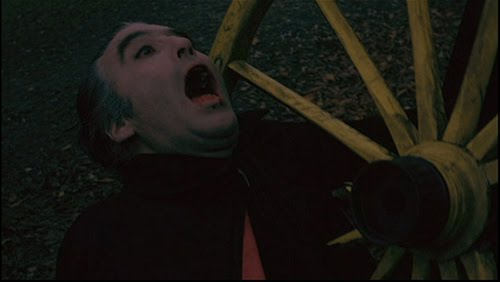
Beginning in 1958, with Horror of Dracula, Hammer films cast Christopher Lee as Count Dracula seven times. In 1972, they finally bring Dracula to the present with Dracula AD, 1972. Sensing the shift of favor from the Victorian gothic horrors to more modern takes on horror themes, for example Count Yorga, Vampire, Blacula and The Night Stalker, Hammer presumes to move their hottest commodity to the twentieth century; however, Count Dracula himself seems to remain stuck in the age gone by. It’s an odd mix that works more when the modern story elements are placed in a more gothic backdrop, the old church, for example. It remains a bit jarring when Dracula, dressed in cloak, is juxtaposed against the hippie dress and behavior of the Mods that bring him back to life. Fortunately a descendent of Van Helsing (Peter Cushing) is on hand to do battle with the Count and save the day. Ironically, the most exciting scene is the opening horse driven coach chase set in the Victorian past, pitting the original Professor Van Helsing against Dracula in more accustomed surroundings. Lee's Count Dracula returns in 1973 with The Satanic Rites of Dracula remaining in the present but still doing battle Cushing's Van Helsing.

SANTA in TALES FROM THE CRYPT
Amicus films produces and Freddie Francis directs Tales from the Crypt, an anthology based on the famous EC Comics of the Fifties. In the “All Through the House” episode, Joan Collins faces off against the most unlikely of villains, the jolly old man in big red suite, Santa. However, the holiday hero is not what he seems; here, Santa is an escaped homicidal maniac in disguise, who ends up on Joan Collins' door step. In typical EC fashion, all is not what it seems and Joanne (Collins) Clayton is not as innocent a victim as the premise leads you to believe. The bloodthirsty Santa has his hands full as he chases his prey around her house. This, in many ways is a precursor to the "final girl" themed films of the Eighties and sets the sub-genre for Christmas/Santa themed horrors to come: Silent Night, Bloody Night (1974), Christmas Evil (1980) and Silent Night, Deadly Night (1984) to name a few.

COUNT MITTERHAUS in VAMPIRE CIRCUS
Hammer is known for its vampires, Count Dracula (Horror of Dracula), Carmilla Karnstein (Vampire Lovers), Baron Meinster (Brides of Dracula), Dr. Ravna (Kiss of the Vampire) and more. In 1972, director Robert Young and writer Judson Kinberg create one of the most unique and unconventional vampire stories to date, Vampire Circus. In a ten minute introduction, the people of Schettel confront and stake the evil vampire ruling the countryside, Count Mitterhaus. In his final moments, Mitterhaus curses the townsfolk and their descendents. For the next fifteen years, the town is ruined by hardship and plague, so much so the town is quarantined by neighboring communities. Then, a troupe of performing gypsies arrives into town, calling themselves the Circus of Night. They are not here to entertain Schettel but to resurrect Count Mitterhaus. Soon the vampire is alive again and the townsfolk must oppose him yet again. Robert Tayman’s Count Mitterhaus is as commanding a presence as Lee’s Dracula, more so than other attempts at lead Hammer vampires would be, but his villainy is undermined by minimal screen time and a script that has him defeated twice by the same hero in less than 90 minutes.

KILLER GIANT BUNNIES in NIGHT OF THE LEPUS
Much like the science fiction mutated monsters of the Fifties, the nature-runs-amok monsters of the Seventies terrorize seemingly innocent small-town inhabitants; however, instead of being created by bombs and radiation, now they're created by ecological disasters, pollution or chemicals. In Night of the Lepus, a town is invaded by thousands of rabbits when their natural predator, the coyote, has been killed off. Scientists, in efforts to avoid using cyanide poisoning to reduce the population, attempt to quell their breeding cycle with hormones. Soon they are faced with giant carnivorous rabbits. Giant killer bunnies may be the silliest movie monster to ever grace the movie screen. Director William F. Claxton uses superimposed real rabbits and small sets to film the killers in action, and it just does not work. However, regardless of how unconvincing they are, the killer bunnies do little to keep further nature-runs-amok films from being made: Frogs (1972), Food of the Gods (1976), Squirm (1976), Day of the Animals (1977) and Prophecy (1979) all quickly followed.